New First Nations funding commitments in this budget
Section 4.3 books $26,649 million, almost all from 2027-28.
Federal Budget 2026 for Indigenous economy and reconciliation: $26,649 million over five years, with only $180 million of it booked for 2026-27.
First Nations housing and infrastructure commitment
$32 billion over 10 years
Cost table books $7,913 million to 2030-31
Chapter 4.3 reconciliation measures, five years
$26,649 million
$180 million of it in 2026-27
Non-Insured Health Benefits Program
$2.9 billion over three years
From 2027-28, nothing booked for 2030-31
Indigenous Loan Guarantee Program
$10 billion
Moves into the Canada Infrastructure Bank
The verdict is net positive and large for services on reserve. Indigenous-specific spending is about $29.9 billion over five years (calculated), but most of it starts in 2027-28, several of the biggest lines renew programs that were due to lapse, and the economic side gets financing tools with little new cash.
| Item | 5-year amount ($M) | What it is |
|---|---|---|
| Chapter 4.3 measures other than clean water | 22,038 (calculated) | Housing, education, children and families, health and safety, fiscal institutions. Net of $958 million sourced from existing departmental resources (both calculated) |
| First Nations clean water infrastructure and legislation | 4,611 | Announced June 16, 2026, booked as a Budget 2026 measure |
| Emergency preparedness in First Nations communities | 2,710 | Announced October 26, 2026. $866 million in 2026-27 pays for emergencies that already happened |
| Partnerships for Indigenous Workforce Readiness Fund | 260 | Net of $192 million from existing resources |
| Smaller Chapter 4 renewals | 230 | Section 35 talks, reserve lands, litigation research, sport, Dechinta, justice, land surveys, NCTR (calculated) |
| CanNor northern development programs | 71 | IDEANorth and the Northern Indigenous Economic Opportunities Program |
| Earlier policy actions † | 60 | Percival settlement, Ajuinnata, Trans Mountain participation (calculated) |
| Budget 2025 review savings, Indigenous Services Canada | -2,470 | $494 million a year, ongoing (five-year total calculated) |
| Budget 2025 review savings, CIRNAC | -346.5 | $69.3 million a year, ongoing (five-year total calculated) |
| Loan guarantees and equity offers | No cost line | Indigenous Loan Guarantee Program, Darlington, Tla'amin, Trans Mountain |
| First Nations income tax and GST arrangements | Not costed | Negotiated with each Indigenous government |
† Earlier decision booked in Budget 2026, Annex 1 policy-actions table, not a new Budget 2026 measure.
A negative figure means offsets or revenue exceed the gross cost, a net gain to the budgetary balance.
The new money is back-loaded. Section 4.3 rises from $180 million in 2026-27 to $7,827 million in 2029-30, then falls to $7,140 million in 2030-31 as the three-year health benefits funding runs out (Chapter 4 cost table). Budget 2026 prints no department-by-department savings table, so the review cuts above are Budget 2025's figures, still in force (Budget 2025: Canada Strong, Annex 3, Tables A3.5 and A3.15). Those two departments give up $563.3 million in 2026-27 (calculated). That is more than three times the new section 4.3 money for the same year. Over five years the sector still comes out about $27.1 billion ahead (calculated).
About a quarter of the five-year total was announced before budget day. The June clean water package and the October emergency management package add up to $7,321 million (calculated). The other large exclusion is the Build Canada Homes expansion. At least 10% of its new $13 billion is reserved for Indigenous housing, at least $1.3 billion over 10 years on a cash basis from 2028-29 (calculated) (Chapter 3, s. 3.2). Its home page is the housing and construction analysis.
| Measure | Net 5-year cost ($M) | Start | What it means for the sector |
|---|---|---|---|
| Investing in housing and infrastructure First Nations communities – Investments to stabilise, accelerate construction, and transform financing* | 7,913 | 2027-28 | First four years of a 10-year, $32 billion plan |
| Supporting Indigenous children and families* | 5,253 | 2026-27 | Jordan's Principle for six years, Inuit Child First, child welfare Act |
| Supporting student success in First Nations communities | 4,796 | 2027-28 | On-reserve K-12 and post-secondary support, five years |
| Investing in housing and infrastructure in First Nations communities – Investments in First Nations clean water infrastructure and legislation* | 4,611 | 2026-27 | Announced in June, rises to $1,898 million in 2030-31 |
| Strengthening health and safety in Indigenous communities* | 3,998 | 2027-28 | Health benefits for three years, policing ongoing (home page) |
| Strengthening emergency preparedness in First Nations communities* | 2,710 | 2026-27 | Reimburses past emergencies, then $461 million a year |
| Helping workers build skills for the jobs of tomorrow | 260 | 2027-28 | New Indigenous workforce fund, partly existing money |
| Supporting participation in negotiations to advance Section 35 rights | 119 | 2027-28 | Treaty and self-government talks, ends 2029-30 |
| Strengthening the fiscal and institutional capacity of Indigenous governments | 79 | 2027-28 | Renews three First Nations fiscal institutions |
| Federal Indian Boarding Homes (Percival) Settlement† | 44 | 2026-27 | Class action settlement, one year |
* Includes capital investment.
† Earlier decision booked in Budget 2026, Annex 1 policy-actions table, not a new Budget 2026 measure.
Housing and infrastructure. The $32 billion has five parts: $18.5 billion for a new First Nations On-Reserve Infrastructure Program, $226.7 million for the Atlantic First Nations Water Authority, $11 billion to stabilise core housing funding, $1.7 billion over five years for shovel-ready housing and $657.5 million for three financing pilots, all from 2027-28 (Budget 2026: Masters of Our Destiny, Chapter 4, s. 4.3). The infrastructure program will "consider opportunities to consolidate existing First Nations on-reserve infrastructure programs." It covers schools and health facilities along with roads and bridges. The pilots are $150 million for the Yänonhchia' Revolving Housing Finance Fund (an estimated 825 housing loans), $7.5 million for a Surety-Bonding Pilot for First Nations contractors and $500 million for a Monetisation Pilot that borrows upfront through the First Nations Finance Authority.
Ownership and finance. The Indigenous Loan Guarantee Program has issued three guarantees. The budget adds the Tla'amin Nation's purchase of 100% of Western Forest Products' Stillwater Forest Operation, and a fifth guarantee for an unnamed oil and gas project is under negotiation (Chapter 4, s. 4.3). The program and Ontario will back an approximately $715 million guarantee for seven First Nations to buy a minority interest in the Darlington New Nuclear Project (Chapter 1, s. 1.2). The program moves into the Canada Infrastructure Bank, which moves to the Minister of Finance (Crown corporations analysis). Annex 3 amends the First Nations Fiscal Management Act so the First Nations Finance Authority can lend to Indigenous-owned special purpose vehicles (Annex 3).
Fiscal arrangements. The First Nations personal income tax revenue-sharing rate rises from 95% to 99%, and participating governments get an annual ceiling on their share of the Canada Groceries and Essentials Benefit. Both depend on negotiations (tax measures analysis).
Asks compiled by Stephen Taylor's AI Public Affairs Toolset, September 15 to November 5, 2026.
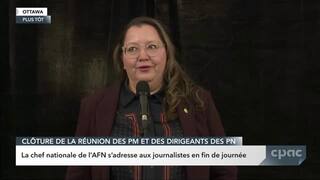
The AFN's call for new money was met in size and missed in timing. The Prime Minister's pre-budget promise of "new measures and investments" for First Nations was delivered, and the policing money announced at the First Nations-First Ministers meeting is booked in the health and safety line. The asks that needed a political process got none: specific claims, a sovereign wealth fund and Indian Act repeal are absent, and the budget instead funds $20 million of litigation research and $8 million of Indian Act land registry work.
First Nations on reserve gain the most. Housing, water, schools, Jordan's Principle and emergency management are all reserve-based programs run through Indigenous Services Canada. The Atlantic First Nations Water Authority's 13 communities in New Brunswick, Prince Edward Island and Nova Scotia get 10 years of funding, the most certain line on the page.
Nations near major projects gain an ownership route that others do not. The seven Williams Treaties First Nations at Darlington, the 128 groups offered 15% of Trans Mountain, the Tla'amin and the communities offered at least 10% of Pacific Link have an ownership route the loan guarantee program is built to finance (Chapter 2, s. 2.1). The Kitikmeot Inuit gain through the Inuit-owned company leading the Grays Bay Road and Port. Communities far from a listed project get no comparable equity tool.
Inuit gain through the $575 million Inuit Child First Initiative and the shift to Pirutsiagutiit, plus the health benefits and policing lines. Métis governments and off-reserve Indigenous people get little. Métis appear in Chapter 4 only in the title of the child welfare Act, and their main housing channel is the Build Canada Homes share starting in 2028-29.
Indigenous financial institutions and contractors gain new business through Yänonhchia', the First Nations Finance Authority and the surety-bonding pilot. Nations in modern treaty talks lose certainty. Their negotiation funding ends in 2029-30, and the National Centre for Truth and Reconciliation and the Indigenous Justice Strategy get one year each.
The government is moving from short envelopes to long commitments. Budget 2025 booked $2,331 million for First Nations infrastructure financing and clean water over three years ending 2028-29 (Budget 2025: Canada Strong, Chapter 3 cost table). Budget 2026 replaces that model with a 10-year plan and six years for Jordan's Principle.
It is also moving from grants to finance. Budget 2025 said it would "explore" a surety backstop and a pilot to monetise federal transfers. Budget 2026 funds both. Loan guarantees move into a Crown lender under Finance, and the First Nations Finance Authority gets a new lending power.
The equity agenda is tied to energy and resources. Pipelines, nuclear power, forestry and an oil and gas guarantee carry the ownership offers. Bill C-39 sets a one-year federal decision target with a new Crown Consultation Hub, and the chapter says it does not change section 35 rights or the duty to consult. A separate $713.8 million over 10 years helps Indigenous, rural and remote communities move off diesel (electricity analysis).
The budget is silent on Inuit Nunangat University. The government said before tabling that it had committed $50 million this year, and the budget neither restates nor adds to it. It names the Urban, Rural and Northern Indigenous Housing Strategy in a list, and an Annex 1 table note mentions funding reallocated to it, with no cost line or amount. The Registered Nurses' Association of Ontario asked that major project decisions assess cumulative health and climate impacts. Bill C-39 speeds decisions and adds no such test. There is no Métis-specific measure and no amount for First Nations school construction separate from the wider infrastructure program.
Federal Budget 2026 and Crown corporations: a $25 billion Canada Strong Fund, a merged BDC and EDC, and $59.1 billion in Crown lending in 2026-27.
Federal Budget 2026 highlights ranked by money and by news value, led by the $36,055 million Productivity Mega Deduction and a merged BDC and EDC.
Federal Budget 2026 projects a $62.3 billion deficit for 2026-27 and spends almost all of a stronger fiscal outlook on measures led by a business write-off.
Federal Budget 2026 puts major transfers to provinces, territories and municipalities at $116.9 billion in 2026-27. Child care drives the gain on Budget 2025.