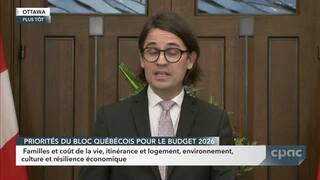
Make Indigenous housing funding permanent and spend what is budgeted
Jean-Denis Garon, Bloc Québécois, CPAC, Nov 4
Core First Nations housing gets 10 years of money, on reserve only.
Federal Budget 2026 for Indigenous Peoples: $26,649 million over five years for reconciliation, but only $180 million of it arrives in 2026-27.
Reconciliation package (Chapter 4, s. 4.3), five years
$26,649 million
Only $180 million of it falls in 2026-27
First Nations housing and infrastructure
$32 billion over 10 years
From 2027-28, $7,913 million booked to 2030-31
Jordan's Principle
$6 billion over six years
From 2026-27
Non-Insured Health Benefits Program
$2.9 billion over three years
From 2027-28, no money booked for 2030-31
Build Canada Homes share for Indigenous housing
At least 10%
Of a $13 billion expansion starting in 2028-29
The bottom line: this budget moves First Nations on reserve from short renewals to 10-year housing and infrastructure money, and that is a real change in how communities can plan. Almost none of it pays out before April 2027, and Métis and urban Indigenous people are left to compete for general streams.
| Change | Amount | Who in this group | When |
|---|---|---|---|
| Gain: housing and infrastructure, 10-year commitment | $7,913 million to 2030-31 ($32 billion over 10 years) | First Nations on reserve | From 2027-28 |
| Re-announced: clean water and Bill C-37 | $4,611 million over five years | First Nations on reserve | Announced June 16, 2026; from 2026-27 |
| Gain: elementary, secondary and post-secondary education | $4,796 million net | First Nations students | From 2027-28 |
| Gain: Jordan's Principle, Inuit Child First, child welfare law | $5,253 million net | First Nations and Inuit children; the law also covers Métis | From 2026-27 |
| Gain: health benefits, public health, policing | $3,998 million | First Nations and Inuit | From 2027-28; health benefits end after 2029-30 |
| Gain: emergency response on reserve | $2,710 million | First Nations | $866 million in 2026-27 |
| Continuing loss: Budget 2025 expenditure review | $494.0 million a year (Indigenous Services) and $69.3 million a year (Crown-Indigenous Relations) | Everyone served by the two departments | From 2026-27, ongoing |
| Expires inside the horizon | $119 million for Section 35 negotiations, $10 million for the Indigenous Justice Strategy | Nations in treaty and self-government talks | After 2029-30 and after 2027-28 |
The new money is far larger than the $563.3 million a year the expenditure review takes from the two departments (calculated) (Budget 2025, Annex 3, Tables A3.5 and A3.15). The timing runs the wrong way for this year, though. The cuts began in 2026-27 and most of the new money begins in 2027-28. The budget does not state a per-person or per-community value for any of these programs.
| Measure | Amount | When | What it means for you |
|---|---|---|---|
| First Nations housing and infrastructure, 10-year commitment | $7,913 million to 2030-31 | From 2027-28 | Core housing money for 10 years, on reserve only |
| Supporting Indigenous children and families | $5,253 million net | From 2026-27 | Six years of Jordan's Principle at about $1 billion a year (calculated) |
| Supporting student success in First Nations communities | $4,796 million net | From 2027-28 | Five years of school funding on reserve |
| Strengthening health and safety in Indigenous communities | $3,998 million | From 2027-28 | Health benefits for three years, policing ongoing |
| Strengthening emergency preparedness in First Nations communities | $2,710 million | $866 million in 2026-27 | Pays for emergencies that already happened, then $461 million a year |
| Pillar 2: Expand non-market housing | $1,498 million booked | From 2028-29 | At least $1.3 billion of $13 billion for Indigenous housing (calculated) |
| Federal Indian Boarding Homes (Percival) Settlement † | $44 million | 2026-27 | Funds the settlement this year only |
† Earlier decision booked in Budget 2026, Annex 1 policy-actions table, not a new Budget 2026 measure.
Two delivery details matter. The new First Nations On-Reserve Infrastructure Program "will consider opportunities to consolidate existing First Nations on-reserve infrastructure programs" (Budget 2026, Chapter 4, s. 4.3). The budget does not say how the move affects communities with projects in current streams. Jordan's Principle shows nothing in the table for 2026-27 because $607 million of existing funds was moved into that year. Another $798 million in 2027-28 comes from existing departmental resources, so the net new figure is smaller than the $6 billion headline.
The asks that matched the government's resource agenda were met in full: exploration credits and northern power. The asks about rights, review standards and service delivery off reserve were not. The housing ask was met only for First Nations on reserve, and for 10 years.
Asks compiled by Stephen Taylor's AI Public Affairs Toolset, September 15 to November 5, 2026.
First Nations on reserve gain the most. Housing, clean water, schools and emergency response all carry long or ongoing money. The $11 billion for core housing over 10 years is meant to maintain 119,000 existing units and build more than 6,900 homes (Budget 2026, Chapter 4, s. 4.3). That works out to about 690 new homes a year over the decade (calculated). The budget does not compare that pace to the housing gap. First Nations governments in tax arrangements also gain. Their personal income tax revenue share rises from 95 to 99 per cent, through negotiated agreements with no date or cost.
Inuit get one program of their own. The Inuit Child First Initiative gets $575 million over five years, along with the move to Pirutsiagutiit. Inuit share the health benefits and policing money with First Nations. Northern residents gain from wider Northern Residents Deductions, worth $99 million over five years. The government's own impacts report rates that change as benefiting mostly higher-income people (Budget 2026, Annex 4). The Inuit page covers the Grays Bay Road and Port and Arctic items.
Métis appear only in the name of An Act respecting First Nations, Inuit and Métis children, youth and families. The Act's implementation gets $806.7 million over five years. Métis can also use streams labelled "Indigenous" in general. These include the Partnerships for Indigenous Workforce Readiness Fund, with $260 million in net new money, the Section 35 negotiation money and the distinctions-based share of Build Canada Homes. See the Métis page.
Urban and off-reserve Indigenous people get no program aimed at them. Budget 2025 confirmed $2.8 billion for urban, rural and northern Indigenous housing (Budget 2025, Chapter 3). Budget 2026 lists that strategy in a housing figure but adds no amount. The general measures still reach this group. The 2027 Canada Groceries and Essentials Benefit Supplement pays up to $339 for a single person, and the impacts report lists Indigenous people among those who benefit (Budget 2026, Annex 4).
Communities near resource projects have a channel the rest do not. The government offered 128 Indigenous groups in Alberta and British Columbia a 15% stake in Trans Mountain. Pacific Link carries an offer of at least a 10% ownership interest. A fifth loan guarantee, for an oil and gas project, is under negotiation (Budget 2026, Chapter 4, s. 4.3). The $10 billion Indigenous Loan Guarantee Program moves into the Canada Infrastructure Bank. Communities far from pipelines, mines and power lines cannot use this kind of support.
Indigenous women and girls get the Red Dress Alert pilot renewed with $3.6 million for 2027-28 only. The pilot is meant to trigger a fast response when an Indigenous woman, girl, Two-Spirit or gender-diverse person goes missing, and it is still a pilot.
The budget is silent on the United Nations Declaration on the Rights of Indigenous Peoples. Budget 2025 tied its major projects agenda to implementing the Declaration, including free, prior and informed consent (Budget 2025, Chapter 1). This budget speeds project approvals and says the one-year timelines leave Section 35 rights and the duty to consult unchanged (Budget 2026, Chapter 2, s. 2.1).
The budget contains no line for Indigenous early learning and child care. It does not mention specific claims, and it has no Métis-specific or urban Indigenous housing amount. Several programs end inside the horizon. The Non-Insured Health Benefits Program gets $2.9 billion over three years, which pays for medical travel, medications and mental health services. Because it stops after 2029-30, the health and safety line drops from $1,364 million in 2029-30 to $324 million in 2030-31. Section 35 negotiation funding stops after 2029-30, and the Indigenous Justice Strategy after 2027-28. The tables mark these with a dash, which means an extension will be considered later. A dash is not a cut, but it puts each program back into a renewal contest before 2031.
| Date | What happens | What it means |
|---|---|---|
| Now (2026-27) | $865.6 million for the Emergency Management Assistance Program covers emergencies on reserve | Reimburses First Nations with unreimbursed emergency costs |
| Before Parliament now | Bill C-37 (First Nations Clean Water Act) and Bill C-39 (Building Canada Strong Act) | Committees are studying each bill |
| Early 2027 | One-time Groceries and Essentials Benefit Supplement is paid | Under the current program the benefit is paid through the tax system |
| 2027 tax year | Wider Northern Residents Deductions apply | Covers 2027 trips |
| April 1, 2027 (2027-28) | Most Chapter 4 programs start: housing, schools, health benefits, policing, child welfare law | The new program uses 10-year housing and infrastructure plans |
| Budget Implementation Act, date not given | Canada Infrastructure Bank Act amendments and First Nations Fiscal Management Act changes letting the First Nations Finance Authority lend to Indigenous-owned special purpose vehicles | Opens a new lending route for equity partners |
| No date | Tax arrangement changes (99 per cent income tax share, ceiling on groceries benefit cost) | The changes depend on negotiations with participating governments |
| 2028-29 | Build Canada Homes expansion begins, with at least 10% for Indigenous housing | The budget does not say how the distinctions-based formula will split the money |
| After 2029-30 | Health benefits and Section 35 negotiation funding need renewal | The 2028 and 2029 pre-budget rounds precede the renewal decision |