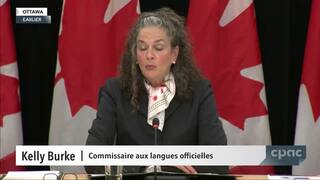
Apply an official-languages lens to spending cuts and AI
Kelly Burke, Commissioner of Official Languages, CPAC, Oct 9
The budget expands AI in government with no language test described.
Federal Budget 2026 for official language minority communities: $300 million more for CBC/Radio-Canada over two years, and nothing for the Action Plan.
Additional funding for CBC/Radio-Canada
$300 million over two years from 2026-27
Budget 2025 gave $150 million in 2025-26
Promoting Francophone culture and the 2028 Francophonie Summit
$393.2 million over three years (cash basis)
$387 million in the accrual cost table
Courts Administration Service, including Official Languages Act compliance
$58 million over four years from 2027-28
Includes cutting the translation backlog
Local Journalism Initiative
$134 million over four years from 2027-28
$41 million ongoing
The budget barely touches the programs that sustain your communities. It funds culture, a 2028 summit and a national broadcaster, and says nothing about minority-language schools, health care, community organizations or immigration.
| Change | Amount | Who in this group | When |
|---|---|---|---|
| Gain: additional funding for CBC/Radio-Canada | $300 million over two years | French-language audiences outside Quebec and English-language audiences in Quebec | 2026-27 and 2027-28 |
| Gain: Local Journalism Initiative | $134 million over four years; $41 million ongoing | Community newspapers and outlets, including minority-language media | From 2027-28 |
| Gain: Canadian Journalism Labour Tax Credit extended to audio and audiovisual newsrooms | $501 million over five years | Community radio newsrooms that qualify | From November 5, 2026; 35% rate to December 31, 2028 |
| Gain: Promoting Francophone culture | $387 million (accrual); $393.2 million over three years (cash) | Francophone artists and organizations, centred on the National Capital Region | 2027-28 to 2029-30 |
| Gain: Early preparations for La Francophonie† | $41 million | Summit planning | 2026-27 |
| Gain: Courts Administration Service | $58 million over four years | People in Federal Court cases who need decisions in their language | From 2027-28 |
| No change stated: Action Plan for Official Languages, education and health agreements | Not in the budget | All minority-language communities | Not stated |
The budget states no per-community or per-organization amount. It does not say how much of the CBC/Radio-Canada money goes to French or English services, or to regional stations.
| Measure | Amount | When | What it means for you |
|---|---|---|---|
| Supporting Canadian stories, journalism, and media | $1,086 million over five years | From 2026-27 | Includes the CBC/Radio-Canada top-up and the Local Journalism Initiative, which reach small and remote markets |
| Canadian Journalism Labour Tax Credit | $501 million over five years | From November 5, 2026 | Community radio newsrooms with two or more arm's-length journalists may now qualify |
| Promoting Francophone culture | $387 million | 2027-28 to 2029-30 | A national showcase for Francophone communities in 2028 |
| Strengthening the Courts Administration Service | $58 million | From 2027-28 | Faster translation of federal court decisions |
| Early preparations for La Francophonie† | $41 million | 2026-27 | Summit planning is funded |
| Canada's first Eurovision Song Contest participation | No separate funding | May 2027 | A CBC/Radio-Canada entry, with no stated language or artist rules |
† Earlier decision booked in Budget 2026, Annex 1 policy-actions table, not a new Budget 2026 measure.
The Summit-related money adds to $428 million (calculated) over the horizon on an accrual basis, of which $280 million falls in 2028-29. Almost all of it ends with the Summit, so it is event spending with little lasting support for community organizations.
Asks compiled by Stephen Taylor's AI Public Affairs Toolset, September 15 to November 5, 2026.
The pre-budget record holds few asks for these communities, and the budget answered neither of them in the asker's favour. The Commissioner's concern about AI is sharpened by Chapter 6. It reports that GCtranslate, an AI translation tool, has translated over 400 million words for more than 70 departments, with 70% of the volume from English to French (Chapter 6, s. 6.2).
Francophones outside Quebec get most of what is here. Annex 4 names French language minorities as beneficiaries of the CBC/Radio-Canada money, the audio and audiovisual support, Promoting Francophone culture and the Courts Administration Service (Annex 4). The chapter text names Francophone communities in Québec and New Brunswick as Summit showcases (Chapter 4).
Francophones in Eastern Ontario and the Ottawa area gain most from the Summit, which is held in the National Capital Region. Franco-Manitobans and Francophones in Western Canada and the North get no named measure.
English-speaking Quebecers get no measure flagged for them. Any benefit comes through CBC's English services and the federal courts, and the budget does not assess either for this group (Annex 4).
Community media gain from two measures. The Local Journalism Initiative is renewed from 2027-28. The labour tax credit now covers audio and audiovisual newsrooms, which could help community radio if stations meet the ownership and staffing tests (Tax Measures: Supplementary Information). Annex 4 does not flag the Local Journalism Initiative for French language minorities.
People with cases before the federal courts gain from the Courts Administration Service money. It funds compliance with the Official Languages Act and a cut to the existing translation backlog, alongside caseload and infrastructure work (Chapter 6 cost table). The budget does not split the $58 million among these purposes, so the share for translation is not stated.
Federal translators and bilingual public servants face a government that is scaling up AI translation, with human review before use (Chapter 6, s. 6.2). The budget does not say how this affects translation jobs or service quality in French.
The budget is silent on the Action Plan for Official Languages, the federal plan that funds community organizations, minority-language schools and health networks. The current plan runs to 2028 (background), within this budget's five-year horizon, and the budget does not address its renewal.
It is silent on minority-language education and early childhood agreements with provinces.
It sets permanent resident targets of 380,000 a year for 2027 to 2029 but gives no target for French-speaking immigrants outside Quebec. It says details will come in the 2026 Annual Report to Parliament on Immigration (Chapter 3, s. 3.4).
It does not revisit the Spring Economic Update 2026 proposal to add the Official Languages Act to the statutes exempted from regulatory sandboxes (Spring Economic Update 2026, Annex 2).
It is silent on minority-language health services, justice services beyond the federal courts, and post-secondary institutions serving minority communities.
| Date | What happens | What it means |
|---|---|---|
| November 5, 2026 | Journalism labour tax credit opens to audio and audiovisual newsrooms | Community radio stations need status as a qualified Canadian journalism organization |
| 2026-27 | CBC/Radio-Canada top-up begins | CBC/Radio-Canada decides how to split the money between services |
| 2027-28 | Local Journalism Initiative renewal, Courts Administration Service funding and Summit funding begin | Community media funding comes through the next intake. The budget gives no date |
| May 2027 | Eurovision Song Contest in Burgas, Bulgaria | None |
| 2028 (the budget gives no date) | Francophonie Summit in the National Capital Region | Community group roles run through Canadian Heritage and Global Affairs Canada |
| December 31, 2028 | 35% journalism labour tax credit rate ends | Affects newsroom budgets from 2029 |
| No date given | 2026 Annual Report to Parliament on Immigration | The report would show any Francophone immigration target outside Quebec |
| No date given | Budget Implementation Act | The budget gives no tabling date |