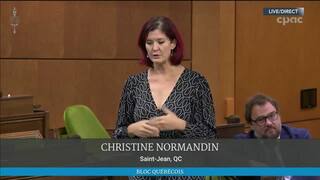
Deliver the promised $600 million for culture
Christine Normandin, Bloc Québécois, House debate on CPAC, Oct 22
The June 3 audiovisual money is booked in the media line.
Federal Budget 2026 for arts, culture and media: $1,086 million for media and CBC/Radio-Canada, with $750 million of it booked in 2026-27.
Supporting Canadian stories, journalism, and media
$1,086 million over five years
$750 million of it in 2026-27
CBC/Radio-Canada, additional funding
$300 million over two years
From 2026-27, nothing booked after 2027-28
Canadian Journalism Labour Tax Credit extension
$501 million over five years
Broadcast newsrooms added, 35% rate to December 31, 2028
National museums and heritage institutions
$783.1 million over five years
Cash basis, from 2026-27
Local Journalism Initiative
$134 million over four years
Then $41 million ongoing
The verdict is net positive for newsrooms and national institutions, with most of the gain in the first two years. Individual creators and screen producers get a tax credit consultation and nothing new for Telefilm, the Canada Media Fund or the Canada Music Fund, whose Budget 2025 envelope ends in 2028-29.
| Item | 5-year amount ($M) | What it is |
|---|---|---|
| Audio and audiovisual support | 600 | Announced June 3, 2026, and booked inside the $1,086 million media line (Chapter 4 cost table, note 1) |
| CBC/Radio-Canada, additional funding | 300 | Two years from 2026-27 |
| Local Journalism Initiative | 134 | Four years from 2027-28, then $41 million ongoing |
| Canada Book Fund and national digital collection | 52.2 (calculated) | $20 million and $32.2 million over four years from 2027-28 |
| Canadian Journalism Labour Tax Credit extension | 501 | Tax relief. Broadcast and podcast newsrooms join print |
| Canada Strong Pass, free museums for under-25s, national institutions | 511 | Accrual. The chapter text commits $965.4 million (calculated) |
| Promoting Francophone culture | 387 | 2028 Francophonie Summit, $280 million of it in 2028-29 |
| Canada 160 | 225 | 2027-28 only, net of $100 million from the Build Communities Strong Fund |
| Canada Council, veterans' legacy, Trudeau records | 59 (calculated) | The Canada Council's $20 million ends in 2029-30 |
| Budget 2025 review savings, Heritage portfolio outside Parks Canada | -521.4 (calculated) | Canadian Heritage, Library and Archives Canada, three museums, NFB, CRTC, Battlefields Commission |
| Productivity Mega Deduction | Share not stated | Economy-wide, $36,055 million. Production equipment qualifies |
| Canada Creative Credit | No cost booked | Consultation, details in the Spring Economic Update 2027 |
A negative figure means offsets or revenue exceed the gross cost, a net gain to the budgetary balance.
The sector's own measures total $2,769 million over five years (calculated). By year they book $776 million, $831 million, $622 million, $270 million and $270 million (calculated). The first two years carry 58% of the money (calculated), and the 2028 Summit props up the third. Budget 2026 prints no new department-by-department review table, so the cuts are Budget 2025's, still in force (Budget 2025: Canada Strong, Annex 3, Table A3.4). Net of them, the sector gains about $2,248 million over five years (calculated). From 2029-30 the net gain shrinks to $139.6 million a year (calculated), and part of that is a tax credit to private newsrooms that does nothing for the departments taking the cut.
Cash and accrual differ on three lines. The museum repairs are $783.1 million and the National Gallery money $60 million on a cash basis. The Summit is $393.2 million in cash against $387 million in the table (Budget 2026: Masters of Our Destiny, Chapter 4, s. 4.1).
| Measure | Net 5-year cost ($M) | Start | What it means for the sector |
|---|---|---|---|
| Kickstarting Canada's Investment Supercycle with the Productivity Mega Deduction* | 36,055 | 2026-27 | Immediate write-off of cameras, lighting and stage gear (tax measures) |
| Supporting Canadian stories, journalism, and media | 1,086 | 2026-27 | June audiovisual money, CBC/Radio-Canada, local news, books |
| Renewing the Canada Strong Pass, making national museums permanently free for children and youth, and supporting national museums and heritage institutions* | 511 | 2026-27 | Repairs and free under-25 admission at national institutions |
| Extending the Canadian Journalism Labour Tax Credit | 501 | Budget Day | Broadcast newsrooms eligible (tax measures) |
| Promoting Francophone culture* | 387 | 2027-28 | 2028 Francophonie Summit in the National Capital Region |
| Celebrating Canada's 160th anniversary | 225 | 2027-28 | One year of festival and Canada 160 funding |
| Making online spaces safe for everyone | 177 | 2026-27 | New platform regulator housed at Canadian Heritage (home page) |
| Preserving the legacy of those who have served Canada | 27 | 2026-27 | National Field of Honour and military commemorations |
| Supporting Canada Council for the Arts | 20 | 2027-28 | Live performance grants for three years |
| Archiving the records of former Prime Minister Trudeau | 12 | 2027-28 | Library and Archives Canada acquisition |
* Includes capital investment.
Journalism. The Canadian Journalism Labour Tax Credit opens to qualifying private audio and audiovisual news organisations for labour costs incurred on or after Budget Day, at the 35% rate and $85,000 per-employee cap that print outlets get (Chapter 4, s. 4.1). The 35% rate, due to fall to 25% on January 1, 2027, now runs to December 31, 2028 for everyone. The cost halves from $170 million in 2028-29 to $85 million in 2029-30, which matches the enhanced rate ending. The Local Journalism Initiative becomes permanent at $41 million a year after its four-year funding.
CBC/Radio-Canada. The broadcaster gets $300 million over two years from 2026-27, after $150 million for 2025-26 in Budget 2025. That makes three years of top-ups with nothing booked for 2028-29. The budget says nothing about the mandate review Budget 2025 promised. Canada enters Eurovision through CBC/Radio-Canada in May 2027, with no separate funding.
Institutions. Admission to national museums becomes free year-round for under-25s, with $46.3 million over five years and $11.5 million ongoing. The $783.1 million in cash goes to the national museums, the National Battlefields Commission, the National Arts Centre and Library and Archives Canada for repairs and collections. The RCMP Heritage Centre in Regina becomes a national museum under a Museums Act amendment, with access to $3 million a year up to 2029-30 (Annex 3).
Creators. The proposed Canada Creative Credit would be a non-refundable personal credit that, with the Basic Personal Amount, recognises up to $45,000 a year of net business income from original artistic work. The budget books no cost. Employed artists lose the $1,000 cap on deductible expenses from 2027, and Table 1 of the tax supplementary information prints no cost for that change (tax measures).
Asks compiled by Stephen Taylor's AI Public Affairs Toolset, September 15 to November 5, 2026.
Asks for more media money were met, and asks about who pays were not. The Bloc's funding asks and the Local Journalism Initiative ask got money. Every ask to make platforms or advertisers pay more went unanswered. Champagne's preview of a budget focused on "cultural sovereignty" matched the chapter's framing, and the leaked funding for cultural institutions arrived as capital for national museums.
Private broadcasters and podcast newsrooms gain the most new support. From Budget Day they can claim a 35% labour credit that only print outlets had. Print newsrooms keep the 35% rate for two more years. Rural and remote news outlets gain a permanent Local Journalism Initiative.
National institutions in Ottawa-Gatineau and their visitors gain. The repair money and the National Gallery's $60 million go to federal Crown institutions. Regional and community museums get no comparable capital line, and Budget 2025 had already narrowed the Canada Cultural Spaces Fund to specialized equipment. The National Capital Region also gets the 2028 Francophonie Summit, and Regina gets a national museum.
Festivals gain one year. Building Communities through Arts and Heritage gets $10 million and the Canada Arts Presentation Fund $15 million, both for 2027-28 only. Publishers gain a renewed Canada Book Fund and a licensing buyer in the national digital collection.
Screen and music producers gain the least from this budget's own measures. Their June money is now booked, but the Budget 2025 envelope for Telefilm, the Canada Media Fund and the Canada Music Fund books nothing for 2029-30. Self-employed artists wait for a credit that has no cost line. The Canada Council's $20 million is about $8 million a year against more than $280 million it awarded in 2024-25, about 3% (calculated).
The government is shifting cultural support from production funds to news and institutions. Budget 2025's largest cultural line was a $402 million, three-year envelope for screen, music and community news. This budget's growth is in tax relief for newsrooms, permanent local news funding and capital for national buildings.
It is using the tax system more. The journalism credit grows, a creators' credit is proposed, employed artists' deductions widen, and the chapter pitches the Productivity Mega Deduction to producers. For CBC/Radio-Canada it keeps to short top-ups. Budget 2025 gave one year, Budget 2026 gives two, and neither sets a multi-year base.
The Artist's Resale Right appears again with the same wording as Budget 2025's Annex 5, now in Budget 2026's Annex 3. Two budgets in a row have promised it without a bill passing.
The budget is silent on Telefilm Canada, the Canada Media Fund and the National Film Board beyond the June money. It mentions the Canada Music Fund only as existing support, with no new money. It proposes no change to the Canadian Film or Video Production Tax Credit and does not mention the Online News Act. A National Post op-ed by Paul Deegan asked the budget to fix the tax treatment of advertising that disadvantages Canadian news outlets, and the budget does not address it. There is no new money for the Canada Periodical Fund and no capital program for non-national museums.
Federal Budget 2026 and Crown corporations: a $25 billion Canada Strong Fund, a merged BDC and EDC, and $59.1 billion in Crown lending in 2026-27.
Federal Budget 2026 tax measures: every proposal, effective date and cost, led by a $4,055 million one-time Canada Groceries and Essentials Benefit top-up.
Federal Budget 2026 for Atlantic Canada: $1.3 billion for Eastern ferries, 14,000 MW at Churchill Falls and Gull Island, and no new money for ACOA.
Federal Budget 2026 for charities and non-profits: $11.2 billion to end homelessness, but no new money for community groups before 2027-28.