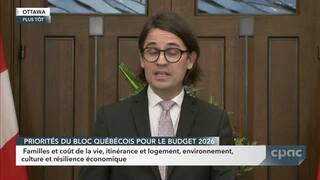
Raise OAS by 10% for seniors aged 65 to 74
Bloc Québécois, Western Standard, Nov 3; Jean-Denis Garon, CPAC, Nov 4
The budget has no OAS measure.
Federal Budget 2026 for seniors: no change to OAS or the GIS, a one-time grocery payment of up to $339 for a single person, and home care funding to March 2028.
Old Age Security program, 2026-27
$89.4 billion
Up 8.0%; rises to $109.5 billion in 2030-31 with no rate change
Maximum OAS and GIS, single senior aged 75 and older (2026)
$23,341
Indexation only; no new OAS or GIS measure
Grocery benefit supplement, single person without children
up to $339
One-time payment in early 2027
Health agreements with provinces and territories
$2.5 billion in 2028-29
Down from $4.3 billion as home care, mental health and long-term care transfers expire after 2027-28
Tax instalment threshold
$7,500
Up from $3,000, from the 2028 tax year
Your OAS and GIS cheques will rise with inflation and nothing else. If your income is low, you get one extra grocery benefit payment in early 2027. If you rely on home care, federal money is secure only to March 31, 2028.
| Change | Amount | Who in this group | When |
|---|---|---|---|
| No change: OAS and GIS | Combined maximum $23,341 for a single senior aged 75 and older | All OAS and GIS recipients | 2026 calendar year amounts |
| Gain: 2027 grocery benefit supplement | Up to $339 for a single person without children | Lower- and modest-income seniors who receive the benefit | Early 2027 |
| Gain: refundable Canada Caregiver Credit | Up to $1,260 a year for caring for an infirm parent or relative | Caregivers with little or no tax payable | 2027 tax year |
| Gain: higher instalment threshold | $7,500, up from $3,000 ($4,500 from $1,800 in Quebec) | Seniors with pension, RRIF or investment income without withholding | 2028 tax year |
| Extended one year: home care and mental health agreements | $1.2 billion in 2027-28 | Seniors using home and community care | To March 31, 2028 |
| Expires: long-term care transfers | $600 million a year | Long-term care residents, through provinces | After 2027-28 |
| Cost: stamp price increase | About $6 a year per consumer | Seniors who use mail | From 2027 |
The budget states per-person values for the grocery supplement, the caregiver credit and the stamp increase only. It gives no estimate of what the instalment change is worth to any one senior, beyond the chapter's example of an Ontario senior with $40,000 of pension income who would stop making quarterly payments of about $750 (Budget 2026, Chapter 6, s. 6.1).
Annex 1 books both expiring health transfers inside the forecast. From 2028-29 the line holds only the $2.5 billion a year for tailored bilateral agreements. That is $1.8 billion a year less than in 2027-28 (calculated).
| Measure | Amount | When | What it means for you |
|---|---|---|---|
| Providing more help with groceries and everyday essentials | $4,055 million in 2026-27 for the supplement | Early 2027 | One payment worth half your 2026-27 maximum |
| Making the Canada Caregiver Credit refundable | $845 million over four years | 2027 tax year | Cash even if you owe no tax |
| Making it easier for Canadians to manage their taxes | $821 million over five years, of which $395 million is instalments | 2027 and 2028 tax years | Fewer instalments, a May 15 filing date, flat claims |
| Improving access to mental health and home and community care | $1,200 million in 2027-28 | To March 31, 2028 | One more year of federal home care money |
| RRSP for life | No cost | Consultation to January 8, 2027 | No forced RRIF conversion at 71 |
| Delivering Canada's National Anti-Fraud Strategy | $6 million over five years | Legislation after consultation | $0 liability for unauthorised bank account access |
| Sustaining the Canadian Dental Care Plan † | $470 million over five years | 2026-27 to 2030-31 | More money to 2028-29, less after |
† Earlier decision booked in Budget 2026, Annex 1 policy-actions table, not a new Budget 2026 measure.
The RRSP-for-life is only an intention. Minimum withdrawals after age 71 stay, and the budget gives no start date (Tax Measures: Supplementary Information, Registered Retirement Savings Plan). The anti-fraud cap applies to transactions from unauthorised access to a bank account, absent gross negligence, once the Bank Act is amended (Budget 2026, Chapter 5, s. 5.3).
The dental plan row adds $855 million over 2026-27 to 2028-29 (calculated) and takes back $385 million in 2029-30 and 2030-31 (calculated). The budget does not explain the cut. It also books a separate $435 million to remit debts under the plan without saying whose (Budget 2026, Annex 1, Table A1.19).
Asks compiled by Stephen Taylor's AI Public Affairs Toolset, September 15 to November 5, 2026.
Asks to raise seniors' core income got nothing. Asks that fit programs the government was already expanding got part of what they sought: the grocery benefit, caregiver support and a one-year home care extension. Health ministers said before tabling that one year was not enough, and the budget adds nothing to the extension Ottawa announced on October 14.
Low-income single seniors gain the most in 2026-27. The chapter puts total grocery benefit support for a single person without children at up to about $1,290 in 2026-27, including the supplement (Budget 2026, Chapter 3, s. 3.1). OAS and GIS add nothing new.
Seniors with pension, RRIF or investment income and a tax bill between $3,000 and $7,500 stop paying quarterly instalments from the 2028 tax year. Annex 4 says this change benefits "majority high-income people." A senior whose income is all withheld at source gains nothing from it.
Seniors caring for a spouse or relative gain if they owe too little tax to use the credit today. Annex 4 lists the refundable credit as benefiting mainly seniors, and the chapter counts 180,000 caregivers who get no benefit now (Budget 2026, Chapter 3, s. 3.1).
Seniors aged 71 and older with RRSPs would no longer have to convert to a RRIF, and a surviving spouse could take over the plan. Annex 4 rates the RRSP change as benefiting "all demographics."
Seniors who rely on home care or live in long-term care face the most uncertainty. Their province's federal money for home care runs to March 31, 2028. The $600 million a year for long-term care expires after 2027-28 with no renewal in the forecast.
Seniors on urban door-to-door mail routes lose it. The budget funds the conversion to community mailboxes with $1.2 billion over seven years, and Annex 4 nonetheless rates the Canada Post measure as benefiting predominantly seniors. See the expenditure review page.
Seniors targeted by fraud gain the $0 liability cap once legislated. Annex 4 rates the anti-fraud strategy as benefiting mainly seniors and newcomers.
Seniors with medical and accessibility costs get simpler claims. A flat $1,000 Home Accessibility claim is available once in a lifetime, and a flat $500 a year covers incontinence products, both from 2027. Prescriptions are no longer needed for insulin and some devices, from the 2026 tax year (Tax Measures: Supplementary Information, Personal Income Tax Measures).
Surviving spouses of pension plan members could be found faster. The CRA would be allowed to tell a plan administrator that a member with an unclaimed benefit has died.
The budget is silent on the Guaranteed Income Supplement. The program appears only in the Budget in Brief, where the combined OAS and GIS maximum for a single senior aged 75 and older is $23,341 for 2026. The spring update printed $23,103 for the same benefits.
The budget is silent on the New Horizons for Seniors Program, which Budget 2025 described as having a $70 million annual budget. It is also silent on renewing the long-term care transfer.
Several pre-budget asks are absent. Entente Education Canada asked for OAS and GIS payments every two weeks, and the budget does not mention payment frequency. CALU asked to allow life annuities inside a TFSA from age 60 or 65, and the RRSP-for-life is the only retirement savings change. Prosper Canada asked that people keep automatic filing once it works for them, and March of Dimes Canada asked for CRA phone support with no time limit. The budget funds $22.3 million in CRA outreach and $30 million for My Service Canada Account help but addresses neither request directly.
| Date | What happens | What it means |
|---|---|---|
| January 8, 2027 | RRSP-for-life consultation closes | Comments go to [email protected] |
| January 2027 | Grocery benefit supplement paid, based on 2025 income | Depends on a filed 2025 return |
| 2026 tax year | Medical Expense Tax Credit documentation changes and $1,000 celiac flat claim | Some receipts are no longer needed |
| 2027 | Stamp price rises to $2.00, then 7% a year | Postage costs rise |
| 2027 tax year | Refundable caregiver credit, $1,000 Home Accessibility and $500 incontinence flat claims, May 15 filing and payment date | Claimed on the 2027 return, due May 15, 2028 |
| 2028 tax year | Instalment threshold rises to $7,500 | Seniors under the threshold can stop quarterly payments |
| March 31, 2028 | Federal home care and mental health agreements end | Any service changes would show up in provincial budgets |
| Not stated | RRSP-for-life start date, anti-fraud legislation | The budget gives no date |
The budget gives no date for the Budget Implementation Act that would enact the tax changes. Under the current program, OAS benefits are fully indexed to inflation (Budget 2026, Annex 1).