Federal support for tariff-hit steel and auto, announced with Ontario (expected)
The Globe and Mail, Oct 21; RDI, Oct 22
The budget books $6.1 billion for Ontario steel, auto and critical minerals.
Follow Stephen Taylor’s newsletter for federal budget intelligence, policy signals, and stakeholder-ready analysis.
Budget 2026 for automakers and parts suppliers: $553 million in new EV charger money, while auto and parts exports to the U.S. are down $6.9 billion.
Supporting Canadian workers and businesses
$11,324 million net over 5 years
Books the tariff packages announced from May to October, including the $6.1 billion Ontario package and targeted auto support, with $2,178 million in 2026-27 (Chapter 2, s. 2.3).
Productivity Mega Deduction
$36,055 million over 5 years
Permanent immediate expensing for most capital assets, which adds little for plants that already expensed machinery and excludes certain passenger vehicles (Chapter 1, s. 1.1).
United States Surtax Remission Order (2025)
$8.9 billion remitted or relieved
Automatic counter-tariff relief for steel goods used in auto manufacturing and non-steel manufacturing inputs, with more Finance staff for individual requests (Chapter 2, s. 2.3).
Expanding Canada's electric vehicle charging infrastructure
$553 million over 5 years
Renews the Zero-Emission Vehicle Infrastructure Program from 2027-28 for over 55,000 more chargers, the only new auto-specific cost line (Chapter 1, s. 1.2).
Helping workers affected by tariffs gain new skills
$170 million in 2027-28
Extends the Workforce Tariff Response one year for laid-off and at-risk workers, charged to the EI Operating Account (Chapter 3, s. 3.4).
“Regional development agencies put almost $170 million into auto firms against a $100 million target, so parts makers are using the tools as fast as they open.”
“Motor vehicle and parts exports to the U.S. are down $6.9 billion from the 2024 average, the largest drop in any category the budget charts, and gains elsewhere of $2.1 billion do not close the gap.”
“Counter-tariffs on U.S. vehicles have raised $0.6 billion net, and the remission order keeps steel for Canadian auto plants duty-free, which protects assembly while the dispute lasts.”
| Measure | Five-year net ($ millions) | 2026-27 ($ millions) | Starts |
|---|---|---|---|
| Supporting Canadian workers and businesses | 11,324 | 2,178 | 2026-27 |
| Productivity Mega Deduction | 36,055 | 2,015 | 2026-27 |
| United States Surtax Remission Order (2025) | no cost line | no cost line | in force |
| EV charging infrastructure | 553 | 0 | 2027-28 |
| Workforce Tariff Response | 170 | 0 | 2027-28 |
Supporting Canadian workers and businesses. The row prints $11,474 million gross, less $150 million from existing resources, and captures packages announced May 4 to October 21 with targeted auto support (Budget 2026: Masters of Our Destiny, Chapter 2, s. 2.3). The $6.1 billion Ontario package to "fortify" the auto industry sits inside it. None of it is a new announcement. See the steel and aluminum sector page, the row's home.
Productivity Mega Deduction. It costs $36,055 million over five years (Budget 2026: Masters of Our Destiny, Chapter 1, s. 1.1). Chart 1.1 puts the tax rate on new manufacturing investment at -0.4% before and -1.2% after, a gain of 0.8 points (calculated). Assemblers already expensed their tooling, so the gain sits mostly with suppliers' customers in other sectors. See the tax measures page.
United States Surtax Remission Order (2025). Steel goods used in auto manufacturing get automatic relief from counter-tariffs, as do non-steel inputs to Canadian manufacturing (Budget 2026: Masters of Our Destiny, Chapter 2, s. 2.3). Across all orders, $8.9 billion of $14.1 billion assessed has been remitted or relieved (Annex 1). For a parts maker, this is the measure that decides input costs. See the automotive sector page.
EV charging infrastructure. The Zero-Emission Vehicle Infrastructure Program gets $587 million over five years from 2027-28 for over 55,000 more chargers (Budget 2026: Masters of Our Destiny, Chapter 1, s. 1.2). It supports EV demand without paying for vehicles or plants. See the automotive sector page.
Workforce Tariff Response. It provides $170 million in 2027-28 for training and employment services with the provinces (Budget 2026: Masters of Our Destiny, Chapter 3, s. 3.4). One year of money means plant-level layoff support depends on another decision in the next budget. See the steel and aluminum sector page.
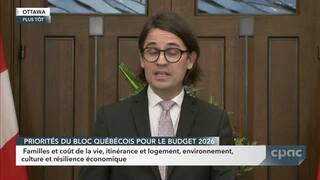
The Bloc asked for $2 billion and for $4 billion. No auto association's ask appeared in the pre-budget record, so the table draws on manufacturers, small business and parties. The Ontario package is the win to claim. Remission speed and building expensing for plants carry into the next cycle.
Asks compiled by Stephen Taylor's AI Public Affairs Toolset, September 15 to November 5, 2026.
An open door for Chinese EVs. The note under Annex 1 Chart A1.4 says the China surtax on electric vehicles was repealed effective March 1, 2026, after raising $4.2 million net. Counter-tariffs on certain U.S. vehicles have applied since April 9, 2025. Canadian plants build for a North American market, so the border now favours Chinese EV imports over U.S.-built vehicles. The budget does not discuss the effect on domestic assembly.
Emissions rules in flux. The government is "updating vehicle greenhouse gas emissions standards to reflect changes in consumer demand and advances in vehicle technology" (Budget 2026, Chapter 1, s. 1.4). No target, model year or date is given. Product plans for 2028 and later depend on that text.
Recovery is slower in autos. The Overview says exports of Canadian-assembled vehicles picked up after retooling and that production is "expected to increase modestly in 2027 amid mixed market conditions." It also warns that industries deeply integrated in North American supply chains "may face longer adjustment periods." Support falls from $4,363 million in 2027-28 to $1,194 million in 2030-31.
Counter-tariffs cut both ways. The plan assumes counter-tariffs into 2027-28 (Annex 1). They protect Canadian assembly but raise costs for any plant importing U.S. parts outside the automatic relief. Individual remission is the only route for those parts, and the budget gives no processing standard.
Financing in transition. BDC and EDC will become one development bank, overseen by a specially constituted board (Budget 2026, Chapter 6, s. 6.3). Products are maintained, but suppliers financing exports and working capital through both will deal with a new institution during the downturn.
Regional and diversification money. Regional agencies invested almost $170 million in automotive against a $100 million target (Budget 2026, Chapter 2, s. 2.3). The largest project example the budget prints is $9,375,000 for Kumi Canada, a Southern Ontario maker of injection-moulded interior parts. The $2 billion Canada Strong Diversification Fund pays for shovel-ready projects, including repairing or replacing equipment and buildings.
Loans and liquidity. The Large Enterprise Tariff Loan Facility now allows more support per firm and longer terms. BDC's tariff programs are open to firms with $1 million or more in revenue, and Pivot to Grow has a new $500 million stream (Budget 2026, Chapter 2, s. 2.3).
Innovation credits. SR&ED will cover certain commercialisation costs, including regulatory approvals or certifications and intellectual property protection, for taxation years that begin on or after Budget Day (Budget 2026, Chapter 1, s. 1.1). The budget expects $930 million in support over five years. Vehicle and component certification costs could fall inside that wording, subject to CRA guidance.
Energy and plant upgrades. SHIFT provides $400 million over seven years from 2027-28 for energy-saving technology at manufacturing facilities (Budget 2026, Chapter 1, s. 1.4).
Battery supply chain. The Matawinie graphite mine, with a planned active anode material plant, is to support the Bécancour battery hub (Budget 2026, Chapter 2, s. 2.1). The Ontario package also builds out critical minerals supply, including the Ring of Fire.
Defence vehicles. The 190 additional Armoured Combat Support Vehicles, worth nearly $2 billion, will be assembled at GDLS-Canada in London, Ontario, with Canadian materials (Budget 2026, Chapter 5, s. 5.1). Figure 5.1 also lists a modernised army logistics vehicle fleet in Ontario.
Workforce. The Workforce Retention and Retraining Program inside the $3.5 billion Rapid Response package helps employers keep workers on the job and train them (Budget 2026, Chapter 3, s. 3.4).
The government wants to keep auto plants and their supply chains in Canada through a trade war it does not expect to end soon. It says Canada and the United States "will not return to our old relationship" (Budget 2026, Chapter 2, s. 2.2). It keeps counter-tariffs on U.S. autos in place even after matching new U.S. tariffs on September 8, 2026, which suggests autos are a bargaining chip in talks.
The Brief frames the Automotive Strategy around EV production, EV incentives and chargers. The chapters add only the charger money. Combined with the emissions-standard rewrite, this suggests the government is easing the pace of the EV transition while it keeps the goal. The fiscal anchors also matter. With the deficit at $62.3 billion in 2026-27 (Annex 1, Table A1.8), new auto money comes as loans, remission and redirected regional funds.
| Date | What happens | What it means for this client |
|---|---|---|
| April 9, 2025 | Counter-tariffs on certain U.S. vehicles took effect | Still in force, $0.6 billion net raised |
| February 16, 2026 | Businesses cannot claim both an EV rebate and immediate expensing on the same vehicle (Spring Economic Update 2026) | Fleet buyers pick one incentive |
| March 1, 2026 | China surtax on electric vehicles repealed | Chinese EVs enter without the surtax |
| June 22, 2026 | Honda Canada Inc. Remission Order implemented | Firm-specific relief is available |
| September 8, 2026 | Proportional countermeasures announced, auto counter-tariffs kept | Border protection for assembly continues |
| November 5, 2026 | SR&ED commercialisation costs eligible for taxation years beginning on or after Budget Day | Certification costs may qualify |
| 2027 taxation year | Apprentice vehicle mechanics' tools deduction simplified | Small help for dealer service shops |
| 2027-28 | Charger program renewal and Workforce Tariff Response start | EV demand support and worker training |
| 2027-28 | Last year of booked counter-tariff revenue | Protection is assumed through this year only |
The Conservatives will set the $9 billion strategy headline against $553 million in new charger money. They are also likely to question the EV transition and attack the $62.3 billion deficit. The emissions-standard rewrite gives them an opening to claim the government is retreating from its own EV policy.
The Bloc Québécois will compare its asks for $2 billion in wage subsidies and $4 billion for EI with a budget that books earlier packages. Labour groups are likely to focus on layoffs, plant retooling and the one-year Workforce Tariff Response.
The Ontario government co-announced the support package and will claim credit for it. The business press is likely to ask why Canada dropped the China EV surtax while keeping counter-tariffs on U.S. vehicles. The Parliamentary Budget Officer is likely to examine the 2027-28 operating surplus, which counts $16.8 billion of forgone tax revenue as capital investment (Annex 1, Table A1.6).