Expand and extend the productivity super-deduction
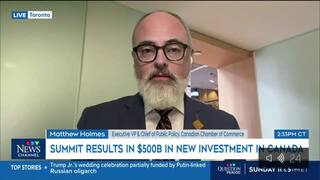
Matthew Holmes, Canadian Chamber of Commerce, CTV News Channel, Sep 15
The Mega Deduction is permanent and booked at $36,055 million.
Federal Budget 2026 for steel and manufacturing: $11,324 million in tariff aid, all announced since May and front-loaded, with steel quotas booked to 2027-28.
Supporting Canadian workers and businesses, net five-year cost
$11,324 million
Previously announced May 4 to October 21, 2026; $11,474 million gross
Tariff support announced since March 2025
almost $44 billion
$16.6 billion of it since the Spring Economic Update 2026
Marginal effective tax rate, manufacturing and processing
-1.2 per cent
From -0.4 per cent after SEU 2026; U.S. rate is 11.1 per cent
Steel tariff-rate quota extension, net revenue
$317 million
$251 million in 2026-27 and $66 million in 2027-28, nothing after
Regional Tariff Response Initiative investment in steel
more than $340 million
Against a target of $150 million
The verdict is positive for the next two years and uncertain after that. Steelmakers and tariff-hit manufacturers keep a large, mostly re-announced support package. The longer-term tools, from trade remedies to a domestic content bonus, are still consultations.
| Item | 5-year amount ($M) | What it is |
|---|---|---|
| Supporting Canadian workers and businesses (1, 2,*) | 11,324 | $11,474 million gross less $150 million from existing resources, all announced May 4 to October 21, 2026 |
| Helping workers affected by tariffs gain new skills | 170 | Training in 2027-28 only, charged to the EI Operating Account |
| Advancing Canada's climate competitiveness | 185 | SHIFT industrial efficiency program, of $400 million over seven years |
| Pillar 3: Building a housing market that works for all* | 468 | Includes $300 million to the Strategic Response Fund for modern construction capacity from 2028-29 |
| Boosting innovation and commercialisation* | 936 | SR&ED expansion, economy-wide |
| Kickstarting Canada's Investment Supercycle with the Productivity Mega Deduction* | 36,055 | Economy-wide immediate expensing; the manufacturing share is not stated |
| Strengthening Canada's defence industrial base* | -39 | $2,602 million gross less $2,641 million previously provisioned or sourced from existing resources |
| Extension of Steel Tariff-Rate Quotas† | -317 | Surtax revenue on over-quota steel, net of remission |
| Budget 2025 review cut to Innovation, Science and Economic Development Canada | -4,288.3 | 723.8, 795.0, 936.5, then 916.5 a year (calculated from Budget 2025, Annex 3, Table A3.16) |
† Earlier decision booked in Budget 2026, Annex 1 policy-actions table, not a new Budget 2026 measure. A negative figure means offsets or revenue exceed the gross cost, a net gain to the budgetary balance.
The tariff row is the sector's money, and none of it is a budget-day decision. The budget counts almost $44 billion in tariff support since March 2025, including $16.6 billion announced since the Spring Economic Update (Budget 2026, Chapter 2, Figure 2.10). The row books $11,474 million gross, so about $5.1 billion (calculated) of the announced figure is not a budgetary cost. That gap is consistent with loans through the Business Development Bank and the Large Enterprise Tariff Loan Facility, which are not expenses. The budget does not reconcile the two figures. Part of the row is Employment Insurance spending that will be "recovered through future EI premiums" under the seven-year break-even rule (Budget 2026, Chapter 2, cost table note 2). Employers and workers will pay that portion back.
The new money announced on budget day is small and late. SHIFT puts $185 million in the horizon and $215 million (calculated) after 2030-31. The $1 billion over six years to recapitalise the Strategic Response Fund starts in 2028-29 and has no visible line in the Chapter 1 cost table (Budget 2026, Chapter 1, s. 1.1). The defence industrial line is a reallocation with a net fiscal impact of -$39 million.
Budget 2025's review cuts to Innovation, Science and Economic Development Canada, the sector's department, total $4,288.3 million over the same years (calculated). They include not renewing the Strategic Innovation Fund's Net Zero Accelerator (Budget 2025, Annex 3). Budget 2026 prints no update to that table.
| Measure | Net 5-year cost ($M) | Start | What it means for the sector |
|---|---|---|---|
| Kickstarting Canada's Investment Supercycle with the Productivity Mega Deduction* | 36,055 | 2026-27 | Permanent expensing of machinery, already near-zero METR for manufacturing |
| Supporting Canadian workers and businesses (1, 2,*) | 11,324 | 2026-27 | Ontario steel package, RTRI, Diversification Fund, EI and retention supports |
| Boosting innovation and commercialisation* | 936 | Taxation years from November 5, 2026 | SR&ED covers certification testing and patent costs |
| Pillar 3: Building a housing market that works for all* | 468 | 2027-28 | Industrial capacity for modular and prefabricated construction |
| Extension of Steel Tariff-Rate Quotas† | -317 | June 27, 2026 | Surtax on over-quota steel imports, booked to 2027-28 |
| Advancing Canada's climate competitiveness | 185 | 2027-28 | SHIFT energy-efficiency projects at industrial plants |
| Helping workers affected by tariffs gain new skills | 170 | 2027-28 | One year of training with provinces |
| Strengthening Canada's defence industrial base* | -39 | 2026-27 | Redirected money, including high-grade ballistic steel |
| Canada's standards-setting and accreditation system | 6 | 2027-28 | Standards Council of Canada help for firms entering new markets |
| Consultations to strengthen the trade remedy system | no cost line | Consultation | Possible legislative and regulatory changes to anti-dumping and countervail |
† Earlier decision booked in Budget 2026, Annex 1 policy-actions table, not a new Budget 2026 measure. A negative figure means offsets or revenue exceed the gross cost, a net gain to the budgetary balance.
Supporting Canadian workers and businesses. The row covers measures announced on May 4, June 3, August 25 and October 21, 2026, including "targeted support announced for steel, aluminum, automotive, copper, forestry, mining, and critical minerals sectors" (Budget 2026, Chapter 2, cost table note 1). The chapter names the parts. There is $6.1 billion to protect Ontario's steel industry, support autos and build Ontario's critical minerals supply chain. The Regional Tariff Response Initiative gets $1.5 billion more, for cash and working capital to small and medium-sized firms. A new $2 billion Canada Strong Diversification Fund backs shovel-ready projects, including repairs to equipment and buildings. A $3.5 billion Rapid Response Supports package adds flexible EI rules, extended benefits and a Workforce Retention and Retraining Program for employers. BDC adds a $500 million Pivot to Grow stream and lowers its minimum revenue test to $1 million. The Large Enterprise Tariff Loan Facility gets larger amounts per firm and longer terms, with no new limits stated (Budget 2026, Chapter 2, s. 2.3). The budget does not say how much of the Ontario package sits in the cost row.
Steel quotas, counter-tariffs and remission. The tariff-rate quota extension was announced June 3 and took effect June 27, 2026, and its revenue is "net of expected remission" (Budget 2026, Annex 1, Table A1.19). The March 2025 counter-tariffs on U.S. steel and aluminum have raised $2.2 billion in net revenue to October 26, 2026, and the China surtax on steel and aluminum $214.0 million (Budget 2026, Annex 1, Charts A1.3 and A1.4). Importers get automatic relief for U.S. steel used in auto and aerospace manufacturing and for non-steel goods used in manufacturing and processing. Other steel users must apply to Finance for individual remission (Budget 2026, Chapter 2, s. 2.3).
Trade remedies and domestic content. Trade remedy duties applied to about $3.3 billion in imports in 2025, across industries employing more than 43,000 Canadians. The budget will consult on legislative and regulatory changes to make the system stronger and more efficient (Budget 2026, Chapter 2, s. 2.2). Separately, a 60-day consultation will design a domestic content bonus of up to 10 percentage points on the Clean Technology investment tax credit and up to 5 points on the Clean Electricity credit, to reward Canadian industrial products in electricity projects (Budget 2026, Chapter 1, s. 1.2).

Asks compiled by Stephen Taylor's AI Public Affairs Toolset, September 15 to November 5, 2026.
The asks that got money were the ones answered before tabling. The Mega Deduction was previewed at the Canada Investment Summit in September, and the steel and auto package was reported before its October 21 announcement. CME's asks on buildings, remission staffing and taxes got little. Budget 2025 already gave immediate expensing for manufacturing and processing buildings, and this budget does not make it permanent.
Ontario steelmakers gain most, with a $6.1 billion package shared with autos and critical minerals and quota protection against offshore steel through 2027-28. Small and mid-sized fabricators gain through the Regional Tariff Response Initiative, where agencies have invested more than $340 million in steel against a $150 million target (Budget 2026, Chapter 2, s. 2.3). Large firms that need liquidity gain from the loan facility changes.
Downstream users of steel are split. Auto and aerospace manufacturers get automatic remission on U.S. steel. Construction, machinery and other fabricators that use U.S. steel pay counter-tariffs unless they win an individual remission. Quotas on offshore steel raise their input costs further.
Aluminum gets no measure of its own. The budget names aluminum among the sectors receiving added initiative money and shows a $1 million grant to Fjordal Aluminium in Québec (Budget 2026, Chapter 2, Figure 2.11). The domestic content bonus, if designed broadly, could reward Canadian aluminum and steel in transmission and generation projects.
Workers get EI flexibility and one year of training money in 2027-28. Because EI costs are recovered through premiums, today's tariff relief raises future payroll costs for the same plants. Defence suppliers gain from support for high-grade ballistic steel and the Defence Investment Agency, but that money is redirected from earlier announcements.
Budget 2025 cited $5 billion over six years for the Strategic Response Fund while cutting ISED's programs (Budget 2025, Annex 3). Budget 2026 recapitalises the fund from 2028-29. This suggests the government expects industrial support to outlast the current tariff package. The shift is toward Crown balance sheets. BDC, the Canada Enterprise Emergency Funding Corporation and Export Development Canada, through a higher Canada Account limit, carry more of the load (Budget 2026, Chapter 2, s. 2.2).
The government now frames trade policy as permanent change. It says "Canada and the United States will not return to our old relationship" and that it walked away when the U.S. "asked too much and offered too little" (Budget 2026, Chapter 2, s. 2.2). The September 8 counter-tariffs match U.S. rates. The fiscal plan still assumes the countermeasures last only through 2027-28. This implies Finance plans for counter-tariffs to end by 2028-29, through a deal or otherwise.
If U.S. tariffs outlast 2027-28, the support row shrinks to between $1,194 million and $1,827 million a year just as the counter-tariff assumption runs out. A new package would add to the deficit. If a deal comes sooner, customs revenue falls faster than planned.
Take-up is uncertain. Pivot to Grow has made about 200 loans worth roughly $250 million to date (Budget 2026, Chapter 2, s. 2.3), a modest pace against the streams on offer. Remission backlogs leave smaller importers paying counter-tariffs while they wait.
Growth is weak. The private-sector average puts real GDP growth at 1.0 per cent in 2026 (Budget 2026, Annex 1, Table A1.2), which caps demand for steel even with protection. The Canadian Tax Observatory has asked Finance to show whether the Mega Deduction produces investment that would not have happened anyway. For manufacturing, with a rate already below zero, that question is sharper.
The budget is silent on any aluminum-specific support. It gives no breakdown of the $6.1 billion Ontario package between steel, autos and minerals. It adds no new money for steel decarbonization after Budget 2025 declined to renew the Net Zero Accelerator. It does not say how the steel quotas will be handled after 2027-28. It prints no updated review table for ISED.
Federal Budget 2026 and Crown corporations: a $25 billion Canada Strong Fund, a merged BDC and EDC, and $59.1 billion in Crown lending in 2026-27.
Federal Budget 2026 highlights ranked by money and by news value, led by the $36,055 million Productivity Mega Deduction and a merged BDC and EDC.
Federal Budget 2026 projects a $62.3 billion deficit for 2026-27 and spends almost all of a stronger fiscal outlook on measures led by a business write-off.
Federal Budget 2026 puts major transfers to provinces, territories and municipalities at $116.9 billion in 2026-27. Child care drives the gain on Budget 2025.