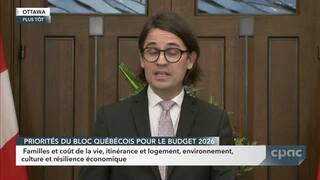
End all federal subsidies to oil and gas
Bloc Québécois, Western Standard, Nov 3, Jean-Denis Garon, CPAC, Nov 4
Well development costs become fully deductible, and Annex 1 books $160 million for Woodfibre LNG.
Federal Budget 2026 for oil and gas: well development costs become 100 per cent deductible, while direct new money is small and Pacific Link is unfunded.
Canadian development expense deduction rate
100 per cent
Up from 30 per cent under the Productivity Mega Deduction
Oil price assumed for 2026 (WTI)
US$85 per barrel
Up from US$73 in the Spring Economic Update 2026; falls to US$69 in 2030
Pacific Link capacity
one million barrels per day
Listed as a project of national interest on October 1, 2026; no cost line
Fuel excise tax relief in 2026-27
$5.3 billion
Full rates return April 1, 2027
LNG Canada capacity after Phase 2
28 million tonnes a year
Construction began September 2026
The budget is mildly positive for producers. The gains come through faster write-offs, a national-interest listing for Pacific Link and looser electricity rules for gas, while direct spending is small. The budget keeps industrial carbon pricing and says nothing about the emissions cap or methane rules.
| Item | 5-year amount ($M) | What it is |
|---|---|---|
| Kickstarting Canada's Investment Supercycle with the Productivity Mega Deduction | 36,055 | Economy-wide tax relief. Well development costs become fully deductible. The budget gives no oil and gas share |
| Lowering costs for Canadians at the pump | 2,870 | Fuel excise relief extension in 2026-27, announced September 2 and re-announced here |
| New Budget 2026 measures aimed at oil and gas | 85 (calculated) | Arctic offshore governance 11, helium tax treatment 54, fuel excise licensing 20 |
| Taxable Canadian Property | 63 | Lower withholding on non-resident sales, including resource property |
| Earlier policy actions (†) | 161 (calculated) | Woodfibre LNG 160 net and Trans Mountain Indigenous participation 1 |
| Projects with no cost line | — | Pacific Link, Pathways, LNG Canada Phase 2, a fifth Indigenous loan guarantee |
| Expenditure review cuts to Natural Resources Canada or Environment and Climate Change Canada | not printed | No department-level cut table in Budget 2026 |
The oil and gas file is a tax and approvals budget. Woodfibre LNG is $200 million gross (calculated) less $40 million from existing Natural Resources Canada resources, all spent by 2028-29 (Budget 2026: Masters of Our Destiny, Annex 1, Table A1.19). The fuel relief is cash to consumers and fuel sellers in 2026-27 only, $5.3 billion in all once the extension is added (Chapter 3, s. 3.1). It cuts other excise taxes and duties by 41.2 per cent to $7.7 billion that year before rates return (Annex 1). None of the sector's new measures is previously provisioned. The bigger fiscal link runs the other way. The budget says income tax growth in 2026-27 is "driven by higher oil prices" (Annex 1). Other program revenues rise 12.5 per cent, partly on higher offshore oil revenues.
| Measure | Net 5-year cost ($M) | Start | What it means for the sector |
|---|---|---|---|
| Kickstarting Canada's Investment Supercycle with the Productivity Mega Deduction* | 36,055 | 2026-27 | Development expense deduction rises from 30 to 100 per cent. Tax measures |
| Lowering costs for Canadians at the pump | 2,870 | 2026-27 | Pump relief to March 31, 2027. Tax measures |
| Support for Woodfibre LNG*† | 160 | 2026-27 | Federal capital support for a private LNG project. Booked before the budget |
| Major Projects Office resources* | 121 | 2026-27 | Pays for Pacific Link listing work. Ends after 2027-28. Public service page |
| Taxable Canadian Property | 63 | January 1, 2027 | Withholding on specified property falls from 50 to 30 per cent. Tax measures |
| Bringing critical minerals from mine to market* (helium component) | 54 | 2027-28 | Helium wells get oil and gas expense treatment. Tax measures |
| Geo-mapping for energy and minerals (GeoNorth)* | 34 | 2027-28 | Northern geoscience data. Critical minerals page |
| Federal fuel excise tax licensing framework | 20 | 2027-28 | Tax once in the supply chain, refunds for past double tax. Tax measures |
| Arctic offshore oil and gas governance | 11 | 2027-28 | Oversight capacity at Crown-Indigenous Relations and Northern Affairs Canada |
| Pacific Link pipeline and Pathways Project | no cost line | Listed October 1, 2026 | National-interest approval track, no federal capital |
* Includes funding classified as a capital investment. † Earlier decision booked in Budget 2026, Annex 1 policy-actions table, not a new Budget 2026 measure.
Pacific Link and Pathways. Pacific Link would carry one million barrels a day of crude 1,250 km from Bruderheim, Alberta, to a deep-water port near Delta, B.C., largely along Trans Mountain's right of way. Indigenous groups are offered at least 10 per cent ownership (Budget 2026: Masters of Our Destiny, Chapter 2, s. 2.1). The budget pairs it with the Pathways carbon capture network and says the two, with Oil Sands Alliance commitments, achieve 16 million tonnes of reductions a year. It names no proponent, cost, financing plan or in-service date for either.
LNG. LNG Canada began Phase 2 construction in September 2026, doubling capacity to 28 million tonnes a year, and Ksi Lisims LNG is on the Major Projects Office list (Chapter 2, s. 2.1). Canada and the European Union will assess the viability of more LNG exports (Chapter 2, s. 2.2). The Major Projects Office portfolio holds 28 initiatives, and its 18 projects represent more than $194 billion in investment.
Approvals and carbon pricing. Bill C-39, the Building Canada Strong Act, targets federal decisions within one year of a complete application. The Canada Energy Regulator would lead reviews of pipelines and offshore energy projects, and some early work could start before a final decision (Chapter 6, s. 6.2). Ottawa intends to update the federal industrial carbon pricing benchmark "to provide greater certainty for industrial emitters" and to work on linking provincial carbon markets (Chapter 1, s. 1.4). Annex 3 proposes removing the four-times penalty rate for late compensation under the Greenhouse Gas Pollution Pricing Act, retroactively.
Indigenous ownership. A fifth Indigenous loan guarantee, for an unnamed oil and gas project, is under negotiation (Chapter 4, s. 4.3). The Trans Mountain stake offer is covered on the pipelines page.

The asks on record for this sector came from taxpayer groups, opposition parties, economists and critics. Few came from producers. Taxpayer and Conservative asks for permanent or wider fuel tax relief got only the temporary extension. The Bloc's ask to end subsidies went the other way, and the Centre for Future Work's profits tax is absent. The Productivity Mega Deduction arrived as signalled in September, at $36,055 million. The fuel excise extension was already before Parliament in Bill C-38, so its $2,870 million is re-announced money. Predictions of higher resource revenue held up in the budget's revenue tables.
Asks compiled by Stephen Taylor's AI Public Affairs Toolset, September 15 to November 5, 2026.
Producers drilling development wells win most. Moving development expenses from a 30 per cent declining-balance deduction to 100 per cent pulls deductions forward for oil sands and conventional drillers (Tax Measures: Supplementary Information, Business Income Tax Measures). The budget's own modelling puts the long-run capital-stock gain for oil, gas and mining below six of the other eight industries it shows (Chapter 1, s. 1.1, Chart 1.2). Assets under "specialised resource-depletion rules" are excluded, which limits the gain for property acquisition costs.
LNG developers win on approvals and federal backing for Woodfibre. Helium explorers get the same expense treatment as gas drillers. Foreign sellers of Canadian resource property win from lower withholding from January 1, 2027.
Fuel wholesalers win a licence they could not get before and a one-time payment for tax paid twice since January 1, 2017. Indigenous communities near pipelines gain equity offers. Fuel retailers and truckers lose the excise holiday in two steps in early 2027. Emitters regulated under industrial carbon pricing face an updated benchmark whose stringency the budget does not state.
Budget 2025 said the oil and gas emissions cap would no longer be required if carbon markets, methane rules and carbon capture delivered (Budget 2025: Canada Strong, Chapter 1). It also promised to finalise enhanced methane regulations. Budget 2026 does not mention either. The climate case for the sector now rests on Pathways, the 16 million tonne figure and the industrial carbon price.
The government's tool for oil is now the approvals system and Crown or Indigenous equity. Budget 2025 referred LNG Canada Phase 2 and Pathways Plus to the Major Projects Office. Budget 2026 lists Pacific Link as a national-interest project and offers Indigenous groups ownership in both Trans Mountain and Pacific Link. The planned changes to the Clean Electricity Regulations add near-term room for natural gas in power generation, which widens the domestic gas market (Chapter 1, s. 1.2).
The fiscal plan uses WTI at US$85 for 2026 and US$79 for 2027, falling to US$69 by 2030 (Annex 1). The budget notes prices near US$100 since its survey. In its supply disruption scenario, with oil at US$88 in 2026 and US$86 in 2027, the deficit grows by $2.2 billion a year on average (Annex 1, Table A1.12). Revenues fall $0.6 billion and expenses rise $1.6 billion a year, so higher oil does not rescue the balance in that case.
Pacific Link has a listing and a route but no proponent, price or capital plan in the budget. Bill C-39 is not yet law, so the one-year review target is a proposal. The Productivity Mega Deduction itself still needs legislation, released as proposals on September 15, 2026. The benchmark update could raise or lower costs for large emitters, and the budget gives no date or price path.
Producers can plan development drilling around immediate write-offs once the deduction is enacted. Helium explorers can apply the new rules to expenses incurred from Budget Day. Fuel wholesalers have two years after royal assent to apply for the double-tax payment.
Indigenous groups can pursue equity through the $10 billion Indigenous Loan Guarantee Program, now moving into the Canada Infrastructure Bank, and through the Trans Mountain offer. Proponents can seek a Major Projects Office referral and, once it exists, a minority co-investment from the Canada Strong Fund on private-sector terms (Chapter 2, s. 2.1). Carbon capture projects can rely on the Carbon Capture, Utilization and Storage investment tax credit, whose July 23, 2026 legislative proposals the budget confirms.
The budget is silent on the emissions cap, the methane regulations and the Clean Fuel Regulations' future beyond listing "amendments" as underway. It does not mention carbon contracts for difference, which Budget 2025 said the Canada Growth Fund would keep issuing. It gives no update on Budget 2025's accelerated capital cost allowance for low-carbon LNG facilities. It has no measure for oil and gas workers, and no federal money for Pathways beyond the existing tax credit.
Federal Budget 2026 fiscal deep dive: the deficit path, the operating anchor, debt charges and a $149.5 billion cash requirement in 2026-27.
Federal Budget 2026 highlights ranked by money and by news value, led by the $36,055 million Productivity Mega Deduction and a merged BDC and EDC.
Federal Budget 2026 projects a $62.3 billion deficit for 2026-27 and spends almost all of a stronger fiscal outlook on measures led by a business write-off.
Federal Budget 2026 puts major transfers to provinces, territories and municipalities at $116.9 billion in 2026-27. Child care drives the gain on Budget 2025.