Return counter-tariff revenue to businesses hit by the trade war
CFIB, release, Oct 29
Remission has returned $8.9 billion of the $14.1 billion assessed.
Remission order, above
Federal Budget 2026 gives trade diversification about $210 million in trade-policy lines and assumes counter-tariffs that netted $5.2 billion end after 2027-28.
Gross counter-tariff revenue assessed since March 4, 2025
$14.1 billion
$8.9 billion remitted or relieved, $5.2 billion net
Customs import duties, 2026-27
$11.1 billion
up 7.8%
Tariff relief announced since March 2025
nearly $44 billion
$16.6 billion since the Spring Economic Update 2026
Forestry Sector Accelerator through the Canada Account
$4 billion
over six years from 2027-28, cash basis
The verdict is neutral to modestly positive. Diversification runs through trade agreements, Export Development Canada financing and infrastructure funds announced earlier. New trade money is small, and the budget does not mention the Canada-United States-Mexico Agreement (CUSMA) once.
| Item | 5-year amount ($M) | What it is |
|---|---|---|
| Supporting Canadian workers and businesses* | 11,324 | Tariff relief announced May 4 to October 21, 2026, re-announced |
| Strengthening Canada's forest sector* | 2,216 | Accrual cost, separate from $4 billion in cash through the Canada Account |
| Bringing critical minerals from mine to market* | 1,348 | Includes Global Affairs work on minerals trade |
| Reinforcing Canada's border infrastructure | 192 | CBSA border technology |
| Canada Investment Summit and Invest in Canada | 181 | Foreign investment attraction from 2027-28 |
| Helping workers affected by tariffs gain new skills | 170 | One year, 2027-28, charged to the EI account |
| Trade-policy lines (sanctions, standards, digital trade, forced labour, trade agreements) | 210 (calculated) | 25 + 6 + 51 + 68† + 60† |
| Surtax and remission orders since the Spring Economic Update † | -312 (calculated) | Steel tariff-rate quotas -317, cabinet and vanity surtax -42, Russian goods remission 43, e-bike inputs 10, canned vegetables -6 |
| Trade Diversification Corridors Fund and Arctic Infrastructure Fund | not in this budget's tables | $5 billion and $1 billion, launched under Budget 2025's Trade Infrastructure Strategy |
| Expenditure review cuts at Global Affairs, CBSA, Finance and ISED | not printed | Budget 2026 does not break savings down by organization |
* Includes funding classified as a capital investment.
† Earlier decision booked in Budget 2026, Annex 1 policy-actions table, not a new Budget 2026 measure.
A negative figure means offsets or revenue exceed the gross cost, a net gain to the budgetary balance.
The big numbers on this page belong to other sectors. The $11,324 million tariff row funds steel, autos, forestry, mining and broad worker support, all announced between May and October (Budget 2026: Masters of Our Destiny, Chapter 2 cost table, note 1). The budget counts nearly $44 billion in tariff relief since March 2025, with $16.6 billion of it announced since the Spring Economic Update 2026 (Budget 2026: Masters of Our Destiny, Chapter 2, s. 2.3). The trade file's own money is the $210 million in trade-policy lines (calculated). Surtax and remission decisions since the spring add a net $312 million to revenue (calculated), mostly from extending steel tariff-rate quotas. The infrastructure funds are older money.
The cash and accrual figures differ sharply in forestry. The cost table books $2,216 million for the forest package. The chapter also puts $4 billion over six years in cash through the Canada Account for a new Forestry Sector Accelerator (Budget 2026: Masters of Our Destiny, Chapter 1, s. 1.3). Under the current program, the Canada Account is the government's own account, administered by Export Development Canada, so its loans carry federal risk.
| Measure | Net 5-year cost ($M) | Start | What it means for the sector |
|---|---|---|---|
| Supporting Canadian workers and businesses* | 11,324 | 2026-27 | Tariff relief for exposed firms, previously announced |
| Strengthening Canada's forest sector* | 2,216 | 2027-28 | Product diversification for a tariff-hit export sector |
| Bringing critical minerals from mine to market* | 1,348 | 2026-27 | Minerals supply chains with EU and allied partners |
| Extension of Steel Tariff-Rate Quotas † | -317 | 2026-27 | Surtax on steel imports above quota, runs to 2027-28 |
| Reinforcing Canada's border infrastructure | 192 | 2027-28 | More reliable border systems for goods |
| Unleashing billions for Canadian businesses with the Canada Investment Summit | 181 | 2027-28 | Invest in Canada offices in key global markets |
| Helping workers affected by tariffs gain new skills | 170 | 2027-28 | Training for laid-off workers, one year only |
| Preventing forced labour in Canadian supply chains † | 68 | 2026-27 | CBSA and Global Affairs enforcement on imports |
| Resources for advancing new trade agreements † | 60 | 2026-27 | $12 million a year for negotiators |
| Modernising trade systems – Digital trade* | 51 | 2026-27 | Paperless trade documents, two years |
* Includes funding classified as a capital investment.
† Earlier decision booked in Budget 2026, Annex 1 policy-actions table, not a new Budget 2026 measure.
A negative figure means offsets or revenue exceed the gross cost, a net gain to the budgetary balance.
Counter-tariffs and remission. Canada added proportional countermeasures on September 8, 2026, at rates matching U.S. tariffs, and kept existing counter-tariffs on autos and other goods (Budget 2026: Masters of Our Destiny, Chapter 2, s. 2.2). Importers can get automatic relief under the United States Surtax Remission Order (2025) for steel used in auto and aerospace manufacturing and for non-steel inputs to manufacturing, food packaging and farming. Relief also covers more than 500 products not made in Canada. Other firms apply to Finance for individual remission, and the budget says it is adding resources without giving an amount (Budget 2026: Masters of Our Destiny, Chapter 2, s. 2.3). Customs import duties are forecast at $11.1 billion in 2026-27, up 7.8% (Budget 2026, Annex 1).
New agreements. Canada concluded agreements with Ecuador, Indonesia and the United Arab Emirates. It expects to complete deals with ASEAN, the Philippines, India and Mercosur in the coming months, and opened talks with Thailand and Türkiye (Budget 2026: Masters of Our Destiny, Chapter 2, s. 2.2). The government says this would take preferential access from 1.5 billion to more than 3 billion consumers. At the October summit, Canada and the EU launched the Alliance for the Future and concluded a Digital Trade Agreement. Canada will also seek to become the EU's first Associate Member. Finance and Global Affairs get $12 million a year for trade negotiations (Budget 2026, Annex 1, Table A1.19).
Trade finance. The budget proposes to raise the Canada Account limit and modernise its governance, but it does not say what the new limit is (Budget 2026: Masters of Our Destiny, Chapter 2, s. 2.2). The Canadian Commercial Corporation becomes a subsidiary of Export Development Canada. Export Development Canada is then to merge with BDC into a single development bank, covered on the Crown corporations page.
Trade remedies. Duties applied to about $3.3 billion in imports in 2025, in industries employing more than 43,000 people. The government will consult on legislative and regulatory changes to make the system faster and stronger, with no date given.
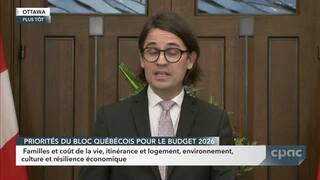
Asks compiled by Stephen Taylor's AI Public Affairs Toolset, September 15 to November 5, 2026.
The Bloc's cash asks for workers, firms and forestry got little new money. The budget relies on programs announced in August and on future EI premiums. Business asks about the remission process got a promise of resources without a figure. Investment attraction got funded. Producers worried about the deals Ottawa is negotiating, cattle and supply management, got no reassurance in the text. Reporters expected continued help for tariff-hit workers and businesses, and that help is in the budget as re-announced money.
Firms selling to Europe and Asia gain most from the agreements and the EU Digital Trade Agreement, but only firms with the capacity to enter new markets can use them. Forest product makers planning biorefineries or higher-value plants can tap the $4 billion Forestry Sector Accelerator. Critical minerals projects gain access to European Investment Bank capital under the new treaty framework. Defence suppliers gain through Canada's participation in the EU's Security Action for Europe, backed by a €150 billion loan facility.
Canadian steel producers gain from the extended tariff-rate quotas, which raise $317 million from imports above quota. Steel buyers pay that surtax. Manufacturers and food processors that import U.S. inputs keep automatic remission. Importers outside the automatic categories wait for individual decisions. Importers of certain wood cabinets, vanities and canned vegetables pay surtaxes under orders made since the spring.
Cattle and supply-managed farmers carry the risk of Mercosur and other deals with no assurance in the budget. Exporters still selling mainly to the United States get no new direct help beyond the re-announced relief. Clients of the Canadian Commercial Corporation face two reorganisations in a row, into Export Development Canada and then into the merged bank.
The budget states that Canada and the United States will not return to their old relationship (Budget 2026: Masters of Our Destiny, Chapter 2, s. 2.2). The policy response is to diversify through agreements and allied finance, with a sharp turn toward Europe. Budget 2025 launched the Trade Infrastructure Strategy and its corridor funds. Budget 2026 adds little infrastructure money and moves to institutions. It raises the Canada Account limit, moves the Canadian Commercial Corporation into Export Development Canada and plans one federal development bank. Support is shifting from grants toward loans and Crown financing, as the forestry accelerator shows. The defensive tools are getting stronger too, through trade remedy consultations, forced labour enforcement and sanctions funding.
The revenue plan assumes counter-tariffs stay into 2027-28 and then end (Budget 2026, Annex 1). If a U.S. deal removes them sooner, customs revenue falls sooner. If talks fail and they stay, revenue runs higher but so does the cost to importers. The budget's two economic scenarios cover higher investment and Middle East supply disruptions. Both refer to U.S. trade-policy uncertainty, and neither models a specific tariff escalation or a trade deal. Private-sector forecasters estimate U.S. tariffs cut real GDP growth by about 0.3 percentage points in both 2026 and 2027 (Budget 2026, Annex 1).
The Mercosur, ASEAN, India and Philippines deals are targets for the coming months. None is signed. The Canada Account increase has no stated size, so the new limit will first appear in legislation. The Export Development Canada and BDC merger could slow trade finance during the transition. The budget says existing products will be maintained. The tariff-worker training money covers only 2027-28.
The budget is silent on CUSMA and its review. It gives no new Canada Account limit, no amount for remission processing and no date for the trade remedy consultations. It does not mention canola, whose market and biofuel demand the Canola Council raised with Ottawa before the budget. The Frontier Duty Free Association's requests on tariff relief access and tobacco excise, made at FINA on October 6, are not addressed. CFIB's request to open tariff relief to firms under $1 million in revenue is scored on the small business page. The budget also gives no export target or measure of diversification beyond the share of exports going to markets other than the United States.
Federal Budget 2026 and Crown corporations: a $25 billion Canada Strong Fund, a merged BDC and EDC, and $59.1 billion in Crown lending in 2026-27.
Federal Budget 2026 finds $2,053 million in new savings that only fill a Budget 2025 placeholder, while Annex 1 trims forecast spending $12.4 billion a year.
Federal Budget 2026 highlights ranked by money and by news value, led by the $36,055 million Productivity Mega Deduction and a merged BDC and EDC.
Federal Budget 2026 projects a $62.3 billion deficit for 2026-27 and spends almost all of a stronger fiscal outlook on measures led by a business write-off.