Eliminate the industrial carbon tax
The benchmark stays and will be updated.
Follow Stephen Taylor’s newsletter for federal budget intelligence, policy signals, and stakeholder-ready analysis.
Budget 2026 brief for major oil and gas producers: well development costs become fully deductible under the $36,055 million Mega Deduction.
Kickstarting Canada's Investment Supercycle with the Productivity Mega Deduction
$36,055M over 5 years
Raises the deduction rate for Canadian development expense, which covers drilling and completing wells, from 30 per cent to 100 per cent, as part of permanent immediate expensing (Chapter 1, s. 1.1).
Pacific Link pipeline and Pathways Project
No federal cost line
Lists a one million barrel a day West Coast crude pipeline as a project of national interest and pairs it with 16 million tonnes a year of emissions cuts from Pathways and other Oil Sands Alliance commitments (Chapter 2, s. 2.1).
Support for Woodfibre LNG
$160M over 5 years
An earlier Natural Resources Canada decision booked from 2026-27 to 2028-29, the only direct federal money in the budget for a named oil and gas project (Annex 1, Table A1.19).
Updating the federal industrial carbon pricing benchmark
No cost line
Keeps industrial carbon pricing and promises an updated benchmark and linked provincial markets, with no timeline or price path (Chapter 1, s. 1.4).
Updating Canada's Clean Electricity Regulations
$22.9M over 5 years
Gives power generators more room for natural gas in the near term and lets existing plants run longer, which supports gas demand from the power sector (Chapter 1, s. 1.2).
“Making well development costs fully deductible is the most direct support for upstream investment in this budget, and it sits inside a $36,055 million economy-wide measure that every sector shares.”
“Pacific Link can carry one million barrels a day and, the budget says, draw $70 billion to $81 billion in pipeline and upstream investment. It needs a carbon price and a decision date that investors can bank.”
“At US$79 oil in 2027, the fiscal plan already leans on energy revenue, and the budget says prices could average about US$89, so producers are carrying part of the deficit outlook.”
This is a tax and regulatory budget for producers. The money that reaches the upstream comes through faster write-offs and a looser power-sector rule that favours gas. Direct spending is small and mostly booked before the budget. The carbon price, which matters more to project economics than any line in the cost tables, is left open. The budget is silent on the oil and gas emissions cap and on methane rules.
| Measure | Five-year net ($M) | 2026-27 ($M) | Starts | Home page |
|---|---|---|---|---|
| Productivity Mega Deduction | 36,055 | 2,015 | Announced September 15, 2026 | Tax measures |
| Pacific Link pipeline and Pathways Project | No cost line | No cost line | Listed October 1, 2026 | Oil and gas |
| Support for Woodfibre LNG † | 160 | 10 | 2026-27 | Oil and gas |
| Industrial carbon pricing benchmark update | No cost line | No cost line | Not dated | Oil and gas |
| Clean Electricity Regulations update | 22.9 (inside Powering Canada Strong) | Not split by year | Subject to consultation | Electricity and nuclear |
† Earlier decision booked in Budget 2026, Annex 1 policy-actions table, not a new Budget 2026 measure.
Productivity Mega Deduction. Drilling and completion costs become fully deductible in the year incurred. Canadian oil and gas property expense, the cost of buying reserves, stays at 10 per cent, so the change rewards drilling over acquisitions (Tax Measures: Supplementary Information, Helium Exploration, Development and Resource Expenses). Only $2,015 million of the cost falls in 2026-27 (Budget 2026: Masters of Our Destiny, Chapter 1, s. 1.1). The Budget in Brief says eligible investments acquired on or after September 15, 2026 can be deducted right away.
Pacific Link and Pathways. The listing gives a 1,250 km, one million barrel a day line a faster federal approval path. It comes with a minimum 10 per cent Indigenous ownership offer (Budget 2026: Masters of Our Destiny, Chapter 2, s. 2.1). The budget ties it to 16 million tonnes a year of cuts from Pathways and other Oil Sands Alliance commitments. That makes carbon capture a condition of the pipeline story in the government's telling.
Woodfibre LNG. The $200 million gross support is partly paid from existing Natural Resources Canada money, leaving $160 million net (Budget 2026: Masters of Our Destiny, Annex 1, Table A1.19). It was decided before the budget.
Carbon pricing benchmark. The government keeps industrial pricing and says it will update the benchmark and link provincial markets (Budget 2026: Masters of Our Destiny, Chapter 1, s. 1.4). Until the update is published, the value of Pathways credits is unknown.
Clean Electricity Regulations. More room for gas-fired generation in the near term means more domestic gas demand from utilities (Budget 2026: Masters of Our Destiny, Chapter 1, s. 1.2).
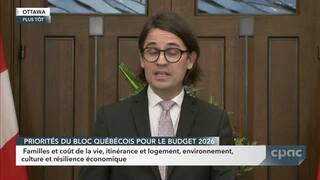
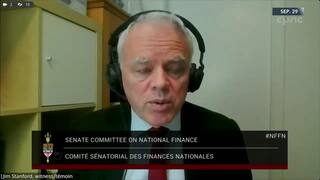

Few asks on record came from producers themselves. Taxpayer groups asked for less carbon policy and got none of it. The Bloc and the RNAO asked for less support and got the opposite. For producers, the carbon benchmark and a Pacific Link proponent and timeline are the next cycle's agenda. The Productivity Mega Deduction arrived as signalled in September, at $36,055 million.
Asks compiled by Stephen Taylor's AI Public Affairs Toolset, September 15 to November 5, 2026.
The largest policy risk is the carbon price. The budget promises "greater certainty" through an updated industrial benchmark. It gives no price path, no date and no word on how provincial systems will be linked (Budget 2026: Masters of Our Destiny, Chapter 1, s. 1.4). The 16 million tonnes a year of Pathways and Oil Sands Alliance cuts depend on that price. A weaker benchmark lowers the value of credits from carbon capture. A stronger one raises compliance costs across the oil sands.
Pacific Link is a listing without money. The budget gives capacity, length, job and GDP estimates but no proponent, no in-service date and no federal financing (Budget 2026: Masters of Our Destiny, Chapter 2, s. 2.1). The government's offer of at least 10 per cent Indigenous ownership has no price or loan guarantee attached. The Major Projects Office funding behind it, $43 million in 2026-27 and $78 million in 2027-28, drops to nothing after that (Budget 2026: Masters of Our Destiny, Chapter 2, Additional investments).
The fiscal plan has a commodity exposure that cuts both ways. Private sector forecasters assumed WTI of US$85 in 2026, falling to US$69 by 2028 (Budget 2026: Masters of Our Destiny, Annex 1, Table A1.2). Annex 1 says WTI has been trading around US$100. If prices stay high, producers carry part of the improvement in the deficit and the windfall tax ask gains force. If they fall faster, revenue weakens just as the Mega Deduction cuts corporate tax to $102.7 billion in 2026-27, from $104.2 billion (Budget 2026: Masters of Our Destiny, Annex 1, Table A1.9).
Regulatory costs rise at the edges. Annex 3 adjusts fines under the Environmental Enforcement Act to inflation and harmonises Species at Risk Act penalties with it (Budget 2026: Masters of Our Destiny, Annex 3). The Clean Fuel Regulations stay, with amendments listed and not described (Budget 2026: Masters of Our Destiny, Chapter 1, s. 1.4).
The Productivity Mega Deduction is the main opening. Canadian development expense, which covers drilling and completing wells and injection, monitoring and waste-disposal wells, would be deducted at 100 per cent (Tax Measures: Supplementary Information, Helium Exploration, Development and Resource Expenses). The legislative proposals were released on September 15, 2026, and the Canada Revenue Agency will rule on whether specific assets qualify once legislation is tabled (Budget 2026: Masters of Our Destiny, Chapter 1, s. 1.1).
Producers with helium prospects gain a second change. Helium exploration and development spending would count as CEE and CDE, and helium property purchases as COGPE, for expenses incurred on or after November 5, 2026. The budget books $4 million for this in 2027-28, rising to $20 million in 2030-31 (Tax Measures: Supplementary Information).
The fifth guarantee under the $10 billion Indigenous Loan Guarantee Program is for an oil and gas project and is under negotiation (Budget 2026: Masters of Our Destiny, Chapter 4, s. 4.3). The budget does not name the project or amount. Annex 3 would also let the First Nations Finance Authority lend to Indigenous-owned special purpose vehicles, a second source of equity financing for partners.
LNG demand has three openings. LNG Canada Phase 2 started construction in September 2026 and doubles capacity to 28 million tonnes a year (Budget 2026: Masters of Our Destiny, Chapter 2, s. 2.1). Canada and the EU will assess the case for more LNG exports to Europe (Budget 2026: Masters of Our Destiny, Chapter 2, s. 2.2). The updated Clean Electricity Regulations would allow more gas-fired power in the near term (Budget 2026: Masters of Our Destiny, Chapter 1, s. 1.2).
Annex 3 would retroactively remove the four-times "increased rate" charged for late compensation under the Greenhouse Gas Pollution Pricing Act and allow refunds of past payments (Budget 2026: Masters of Our Destiny, Annex 3). Facilities under the federal output-based system that paid the increased rate stand to recover it.
The government wants oil and gas growth that it can describe as compatible with net zero by 2050. It calls its approach "balanced" and presents Pacific Link and Pathways as one package (Budget 2026: Masters of Our Destiny, Chapter 2, s. 2.1). The stated goals are market access, "premium prices in growing Asian markets" and a smaller discount on Canadian oil relative to U.S. oil.
The tax side serves a wider aim. The Mega Deduction is the centre of the budget's "investment supercycle." The budget says it cuts the marginal effective tax rate on new business investment from 13 per cent to 6.4 per cent (Budget 2026: Masters of Our Destiny, Chapter 1, s. 1.1). Upstream drilling is one of many beneficiaries. This suggests the government prefers broad tax relief that it can defend as sector-neutral over named subsidies to oil and gas.
Fiscal anchors also shape the approach. The budget counts capital-focused tax incentives as capital investment, so the Mega Deduction does not count against the day-to-day operating balance. That balance turns to an $11.2 billion surplus in 2027-28 (Budget 2026: Masters of Our Destiny, Annex 1, Table A1.6). Support delivered through the tax system is cheaper for the government to give under its own rules than program spending.
| Date | What happens | What it means for this client |
|---|---|---|
| September 15, 2026 | Productivity Mega Deduction announced and legislative proposals released | Draft rules for the 100 per cent CDE rate are public |
| September 21, 2026 | Bill C-39, the Building Canada Strong Act, introduced | One-year federal decisions with the Canada Energy Regulator as lead for pipelines |
| October 1, 2026 | Pacific Link listed as a project of national interest | The line is on the streamlined approval path |
| November 5, 2026 | Helium expenses begin to qualify as CEE, CDE and COGPE | Applies to helium spending from Budget Day |
| November 6, 2026 | Relieving rules for fuel manufacturers under the fuel excise licensing changes take effect | Applies to refiners and other fuel manufacturers from the day after Budget Day |
| End of 2026 | Draft Made-in-Canada sustainable investment criteria for electricity, transportation and buildings | Oil and gas is not among the first sectors covered |
| February 2027 | Sustainable Finance Conference hosted by the Canadian Climate Institute | Investors see where the taxonomy is heading |
| 2027-28 | Last year of Major Projects Office resources and first year of Arctic offshore oil and gas governance funding | Federal project support thins out after this year |
For government. Making well development costs fully deductible is the most direct support for upstream investment in this budget, and it sits inside a $36,055 million economy-wide measure that every sector shares. The frame answers the subsidy charge by pointing to the measure's breadth.
For investors. Pacific Link can carry one million barrels a day and, the budget says, draw $70 billion to $81 billion in pipeline and upstream investment. It needs a carbon price and a decision date that investors can bank. The supporting figures are the 1,250 km route and the 16 million tonnes a year of Pathways cuts.
For media. At US$79 oil in 2027, the fiscal plan already leans on energy revenue, and the budget says prices could average about US$89, so producers are carrying part of the deficit outlook. The supporting figures are the $62.3 billion deficit for 2026-27 and the $34 billion improvement since the spring over six years.
The Conservatives and the CTF will say the budget kept the industrial carbon tax and the Clean Fuel Regulations. They will point to a listed pipeline with no money and no date, against a CBC reporter's expectation that the budget would give specifics, dollars and timelines for major projects. The listing helps producers but gives the opposition a line on delivery.
The Bloc Québécois, the Greens and groups like the RNAO will call the 100 per cent CDE rate and the Woodfibre money new fossil fuel subsidies. The budget's own environmental assessment says the Mega Deduction could raise emissions through faster growth and that its net effect cannot be determined (Tax Measures: Supplementary Information). Critics will quote that line.
The Parliamentary Budget Officer and fiscal commentators are likely to focus on the operating balance. It counts $16.8 billion of forgone revenue from capital tax incentives as revenue in 2027-28 (Budget 2026: Masters of Our Destiny, Annex 1, Table A1.6). Without that add-back, the balance turns positive only in 2028-29 (calculated). Producers benefit from the incentive that is drawing the scrutiny.
The business press will lead with the drop in the marginal effective tax rate to 6.4 per cent. Energy reporters are likely to note that oil prices explain much of the revenue gain since the spring. Nominal GDP is about $48 billion a year higher than in April, mainly from commodity prices (Budget 2026: Masters of Our Destiny, Economic and Fiscal Overview).
WTI prices against the budget's US$85 for 2026 and US$79 for 2027 are the first number to track. The global supply disruptions scenario uses US$86 for 2027. It adds $2.2 billion a year to the deficit on average (Budget 2026: Masters of Our Destiny, Annex 1, Table A1.12). The exchange rate assumption of 72.4 US cents in 2027 also sets Canadian-dollar netbacks.
Corporate income tax revenue is the second. It falls to $102.7 billion in 2026-27 as the Mega Deduction starts (Budget 2026: Masters of Our Destiny, Annex 1, Table A1.9). Its path will show how much of the measure producers and other firms claim.
The carbon benchmark update, the Clean Electricity Regulations draft and the Clean Fuel Regulations amendments are the regulatory milestones, likely through the Canada Gazette. Bill C-39's progress, the Trans Mountain stake sale to 128 Indigenous groups and any Pacific Link proponent announcement will show whether the pipeline moves from listing to construction. The Main Estimates will show whether Woodfibre's $75 million for 2027-28 and the Major Projects Office money appear as booked. The spring economic and fiscal update will restate the oil price and revenue outlook.