Reimburse Quebec's 2024 asylum-seeker costs (Quebec spent $733 million)
Government of Quebec, release, Nov 4; Montreal Gazette, Nov 4; RDI, Nov 4
No reimbursement line for Quebec or any province.
—
Federal Budget 2026 for immigration and settlement: targets held at 380,000 permanent residents, up to 200,000 residents converted, no new settlement money.
Permanent resident admissions target, 2027 to 2029
380,000 a year
Same as Budget 2025 set for 2026 to 2028; 483,655 admitted in 2024
New temporary resident arrivals target, 2027 to 2029
370,000 a year
Same as Budget 2025 set for 2027 and 2028; 686,010 arrived in 2024
Temporary residents offered permanent residency by end of 2027
Up to 200,000
Includes 100,000 workers eligible for Express Entry or the Provincial Nominee Program
Interim Federal Health Program, policy action
$815 million
2026-27 and 2027-28 only; nothing booked after that
The budget is mixed for the sector. It is positive for temporary residents already in Canada and the provinces that nominate them, and neutral to negative for settlement agencies, asylum systems and institutions that depend on new arrivals from abroad.
| Item | 5-year amount ($M) | What it is |
|---|---|---|
| Seven new immigration measures, net | 600 | Sum of the rows in the measures table below except the policy action and the no-cost item (calculated) |
| Of which: levels plan, residency transitions, foreign worker reform | 287 | $511 million gross less $224 million in projected fee revenue |
| Of which: screening, enforcement and removals | 168 | Biometrics, CBSA integrity and Afghan resettlement enforcement, RCMP anti-smuggling (calculated) |
| Of which: asylum processing | 63 | $98 million gross less $35 million from existing IRCC, IRB and CBSA resources |
| Of which: Migrant Worker Support Program | 82 | Renewed help for temporary foreign workers facing abuse |
| Interim Federal Health Program † | 815 | Health coverage funded in 2026-27 and 2027-28 only |
| New settlement and language training money | 0 | No line in any chapter |
| Budget 2025 IRCC spending cuts | not restated | $619.1 million in 2028-29 and $614.2 million ongoing, booked in Budget 2025 and left in place |
Budget 2026 adds $881 million (calculated) in gross spending across the seven new measures. Fees of $246 million (calculated) and $35 million of reallocated money bring the net to $600 million (calculated). Almost none of it arrives this year. In 2026-27 the seven measures save a net $17 million (calculated), because existing resources more than cover that year's asylum cost (Budget 2026: Masters of Our Destiny, Chapter 3, cost table). Spending peaks at $183 million (calculated) in 2027-28, the year of the residency transitions.
Against that, the Comprehensive Expenditure Review that Budget 2025 booked for Immigration, Refugees and Citizenship Canada (IRCC) keeps running. It takes $619.1 million out of IRCC in 2028-29 and $614.2 million a year ongoing, through Settlement Program eligibility limits for economic immigrants, an Interim Federal Health Program co-payment and a smaller Interim Housing Assistance Program (Budget 2025: Canada Strong, Annex 3, Table A3.14). In 2028-29, Budget 2026 adds $167 million (calculated) across all seven new measures, including those at the CBSA, the RCMP and Employment and Social Development Canada. The department's operating base is still shrinking. Those cuts are explained on the expenditure review page.
| Measure | Net 5-year cost ($M) | Start | What it means for the sector |
|---|---|---|---|
| Interim Federal Health Program † | 815 | 2026-27 | Coverage for refugees and claimants is booked to 2027-28, then nothing (health page) |
| Building a more responsive and resilient immigration system | 287 | 2026-27 | Levels plan, up to 200,000 residency transitions, foreign worker reform |
| Migrant Worker Support Program | 82 | 2027-28 | Four more years of funding for worker-rights non-profits |
| Supporting the integrity of the immigration system | 73 | 2027-28 | CBSA removals of inadmissible people, three years, then a dash |
| Enhancing biometrics collection for immigration screening | 68 | 2027-28 | Facial images for eTA applicants, partly paid by fees |
| Asylum processing | 63 | 2026-27 | Backlog reduction at the IRB, IRCC and CBSA |
| Supporting enforcement activities related to Canada's Afghanistan resettlement initiatives | 14 | 2027-28 | CBSA enforcement on Afghan arrivals, three years |
| Preventing the smuggling of migrants | 13 | 2027-28 | RCMP anti-smuggling work, two years |
| International Talent Attraction Strategy and Action Plan | no cost row | Budget 2025 | Progress report only (post-secondary page) |
† Earlier decision booked in Budget 2026, Annex 1 policy-actions table, not a new Budget 2026 measure.
Levels plan and transitions. The budget gives IRCC $56.9 million over four years from 2027-28 to run the plan, with $205.4 million in future years (Budget 2026: Masters of Our Destiny, Chapter 3, s. 3.4). Most of that cost falls after the five-year horizon. A further $302.3 million over four years, plus $90.6 million later, pays for up to 200,000 temporary residents to become permanent residents by the end of 2027. Half of them, 100,000 workers, go through Express Entry or the Provincial Nominee Program with the provinces. Budget 2025's equivalent was a one-time transition for up to 33,000 work permit holders at $19.4 million (Budget 2025: Canada Strong, Chapter 1). The new scale is six times (calculated) that number.
Temporary Foreign Worker Program. Employment and Social Development Canada gets $151.5 million over five years from 2026-27 to fit the program to regional labour markets, speed processing and tighten employer compliance (Budget 2026: Masters of Our Destiny, Chapter 3, s. 3.4). The chapter names no cap, wage floor or regional list. Those details will decide which employers gain.
Biometrics. Visa-exempt travellers applying for an electronic Travel Authorization will have to submit a facial image remotely. The $90 million cost is partly offset by $22 million in fees (Budget 2026: Masters of Our Destiny, Chapter 3, cost table).
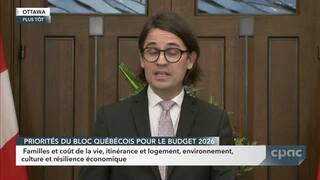
Asks compiled by Stephen Taylor's AI Public Affairs Toolset, September 15 to November 5, 2026.
The asks that came with a dollar figure attached, from Quebec and the Bloc, got nothing. The Conservative call for a cut and the hinted increase both missed. The government held the totals and changed who fills them, converting people already in Canada.
Temporary residents already in Canada win most. Up to 200,000 can move to permanent status by the end of 2027, and 100,000 of those places run through Express Entry and provincial nominee streams. Provinces with active nominee programs gain a larger share of permanent economic immigration, which the chapter says is the intent (Budget 2026: Masters of Our Destiny, Chapter 3, s. 3.4).
Applicants abroad may lose. The budget does not say whether the 200,000 transitions count inside the 380,000 permanent resident target. If they do, then fewer places remain for people applying from outside Canada in 2027.
Settlement agencies lose ground. Budget 2025's limits on Settlement Program eligibility for economic immigrants stand, and Budget 2026 adds no settlement or language training money. A larger share of new permanent residents will be people already here, who may need fewer arrival services. The budget does not draw that link or say whether settlement funding will follow.
Employers of temporary foreign workers face a mixed result. Reform aimed at regional needs and faster processing helps employers outside the big labour markets. Stronger compliance checks and $82 million for worker-rights groups raise the cost of getting it wrong.
Visa-exempt travellers take on a new facial-image step for the eTA. Asylum claimants keep federal health coverage through 2027-28, with no money booked after that year (Budget 2026: Masters of Our Destiny, Annex 1, Table A1.19).
Colleges and universities get nothing to offset the fall in new international students. Arrivals were 71% (156,440) lower in January to August 2026 than in the same period of 2024, and the budget presents that drop as a success (Budget 2026: Masters of Our Destiny, Chapter 3, s. 3.4).
The government has moved from cutting totals to managing composition. Budget 2025 cut temporary admissions from 673,650 in 2025 to 370,000 by 2027 and held permanent admissions at 380,000 (Budget 2025: Canada Strong, Chapter 1, Tables 1.1 and 1.2). Budget 2026 extends those numbers to 2029 unchanged. Against 2024 actuals, that is 46% (calculated) fewer temporary arrivals and 21% (calculated) fewer permanent admissions.
The new emphasis is conversion. Budget 2025 offered permanent status to up to 33,000 workers. This budget offers it to up to 200,000 people and gives provinces a larger role. The 2027-2029 plan is published without the worker and student split that Budget 2025's tables carried. Those details wait for the Minister's 2026 Annual Report to Parliament on Immigration.
Money has also shifted toward integrity work. Four of the seven new rows fund screening, removals and anti-smuggling at IRCC, the CBSA and the RCMP. None funds integration.
The CBSA and RCMP lines end inside the horizon. Integrity and Afghan enforcement funding stops after 2029-30, and anti-smuggling funding after 2028-29. The table's dashes mean an extension will be considered later (Budget 2026: Masters of Our Destiny, Chapter 5, cost table).
The Interim Federal Health Program has $404 million in 2026-27 and $411 million in 2027-28, then zero. If claims rise again or the backlog clears slowly, then IRCC will need a new decision before 2028-29.
The levels plan and transitions rely on fees. Projected fee revenue peaks at $117 million in 2027-28, the year the transitions happen. If uptake is slower, then the net cost rises.
The government still has $0.5 billion in savings to identify for 2027-28, and an average of $1.8 billion a year from 2028-29 to 2030-31 (Budget 2026: Masters of Our Destiny, Chapter 6, s. 6.3). IRCC already carries Budget 2025's savings target of up to 15% over three years and could be asked for more.
The transition window for temporary workers eligible for Express Entry or a provincial nominee stream closes at the end of 2027. Provinces share in choosing the 100,000 workers.
Provincial governments can bid for a larger nominee allocation and shape the regional design of the Temporary Foreign Worker Program reform. The budget commits to doing both with them.
Non-profits that serve migrant workers can apply for the renewed Migrant Worker Support Program from 2027-28, at $20 million a year. Employers in strategic sectors can still use the Global Talent Stream, where labour market assessments take as few as 10 business days (Budget 2026: Masters of Our Destiny, Chapter 3, s. 3.4).
The budget is silent on settlement and language training funding and on any reversal of Budget 2025's Settlement Program limits. It cites past work on foreign credential recognition but adds no money for it (Budget 2026: Masters of Our Destiny, Chapter 3, s. 3.4). It gives no study permit target for 2027 to 2029 and does not mention francophone immigration. It does not restore the Interim Housing Assistance Program that Budget 2025 scaled back.
Federal Budget 2026 finds $2,053 million in new savings that only fill a Budget 2025 placeholder, while Annex 1 trims forecast spending $12.4 billion a year.
Federal Budget 2026 puts major transfers to provinces, territories and municipalities at $116.9 billion in 2026-27. Child care drives the gain on Budget 2025.
Federal Budget 2026 tax measures: every proposal, effective date and cost, led by a $4,055 million one-time Canada Groceries and Essentials Benefit top-up.
Federal Budget 2026's impacts report rates the $36,055 million Productivity Mega Deduction, its largest measure, as benefiting mostly men and high earners.