Forest sector strategy details in the budget (preview)
Tim Hodgson, Natural Resources, release, Oct 14
Chapter 1 sets out three programs starting in 2027-28.
Follow Stephen Taylor’s newsletter for federal budget intelligence, policy signals, and stakeholder-ready analysis.
Budget 2026 brief for forestry companies: $2,216 million for the forest sector over five years, none of it before 2027-28, and no word on softwood duties.
Strengthening Canada's forest sector
$2,216M over 5 years
Funds fibre supply and forest management, mill modernisation and higher-value products through Natural Resources Canada, plus a $4 billion EDC Forestry Sector Accelerator, all starting in 2027-28 (Chapter 1, s. 1.3).
Kickstarting Canada's Investment Supercycle with the Productivity Mega Deduction
$36,055M over 5 years
Permanent full write-off of most capital assets cuts the forestry marginal effective tax rate from 9.5 per cent to 1.8 per cent (Chapter 1, s. 1.1, Chart 1.1).
Supporting Canadian workers and businesses
$11,324M over 5 years
Books the tariff support announced from May to October 2026, including targeted forestry support, the Regional Tariff Response Initiative and the $3.5 billion Rapid Response package (Chapter 2, s. 2.3).
Pillar 2: Expand non-market housing
$1,498M over 5 years
Adds $13 billion in cash over ten years to Build Canada Homes from 2028-29, a source of lumber demand that arrives late in the horizon (Chapter 3, s. 3.2).
Indigenous Loan Guarantee Program: Tla'amin Nation Tree Farm
No cost line
A federal loan guarantee backs Tla'amin Nation's purchase of 100 per cent of Western Forest Products' Stillwater Forest Operation (Chapter 4, s. 4.3).
“The $2,216 million booked for the forest sector over five years starts in 2027-28, so mills facing U.S. duties this year depend on tariff programs announced before the budget.”
“Forestry's marginal effective tax rate falls to 1.8 per cent against 19.7 per cent in the United States, which makes a new mill or biorefinery cheaper to build here than south of the border.”
“Wildfires burned about 4.5 million hectares in 2026, and $500 million over six years for fibre supply and forest management is the only new money aimed at the wood supply itself.”
The budget treats forestry as an industry to rebuild. It counts nearly 200,000 forest sector workers and $29.7 billion of GDP in 2025 (Budget 2026: Masters of Our Destiny, Chapter 1, s. 1.3). Its new money pays for new mills, new products and fibre supply from 2027-28. Relief for the current downturn comes from programs announced between May and October 2026 and from the general tax cut on investment. Larger firms gain most from the EDC accelerator and immediate expensing. Small private forestry firms are shut out of the one new capital gains break.
| Measure | Five-year net ($M) | 2026-27 ($M) | Starts | Home page |
|---|---|---|---|---|
| Strengthening Canada's forest sector | 2,216 | 0 | 2027-28 | Forestry |
| Productivity Mega Deduction | 36,055 | 2,015 | Announced September 15, 2026 | Tax measures |
| Supporting Canadian workers and businesses | 11,324 | 2,178 | Announced May 4 to October 21, 2026 | Steel and aluminum |
| Pillar 2: Expand non-market housing (Build Canada Homes) | 1,498 | 0 | 2028-29 | Housing and construction |
| Tla'amin Nation Tree Farm loan guarantee | No cost line | No cost line | Not dated | Forestry |
Strengthening Canada's forest sector. The chapter lists $500 million for fibre supply and forest management, $2 billion for modernisation and higher-value products, and $4 billion through EDC's Canada Account for a new Forestry Sector Accelerator (Budget 2026: Masters of Our Destiny, Chapter 1, s. 1.3). The table books $554 million a year from 2027-28 and does not split the row among the three parts. The EDC money is counted on a cash basis, so most of its $4 billion will not show up as a cost in the fiscal plan. Budget 2025's $500 million over three years for NRCan forestry programs, which started in 2026-27, is still running when the new money starts (Budget 2025: Canada Strong, Chapter 2).
Productivity Mega Deduction. Forestry's marginal effective tax rate falls to 1.8 per cent, a cut of 7.7 points (calculated), against 19.7 per cent in the United States (Budget 2026: Masters of Our Destiny, Chapter 1, s. 1.1, Chart 1.1). Chart 1.2 projects forestry's capital stock rising 2 per cent over the long run, against 8 per cent for construction. Forestry already had a low tax rate, so the change adds less to returns than in other sectors.
Supporting Canadian workers and businesses. This row books earlier announcements and nets $150 million from existing departmental resources (Budget 2026: Masters of Our Destiny, Chapter 2, s. 2.3). It does not show a forestry share. Forestry firms draw on it through the Regional Tariff Response Initiative, the Canada Strong Diversification Fund and the Large Enterprise Tariff Loan Facility.
Build Canada Homes. The $13 billion cash top-up starts in 2028-29 and takes total capitalisation to $45 billion, aimed at 200,000 homes in the next decade (Budget 2026: Masters of Our Destiny, Chapter 3, s. 3.2). Lumber demand from this line comes late in the horizon.
Tla'amin Nation Tree Farm. The guarantee backs an Indigenous purchase of a whole forest operation from a forest company (Budget 2026: Masters of Our Destiny, Chapter 4, s. 4.3). It is the first forestry deal under the $10 billion program and sets a model for selling tenure to Indigenous owners.
An earlier decision also touches wood products. The Certain Wood Cabinet and Vanity Goods Surtax Order, implemented July 31, 2026, is booked at $42 million in revenue in 2026-27 (Budget 2026: Masters of Our Destiny, Annex 1, Table A1.19). It protects domestic cabinet makers and does not reach lumber or pulp.
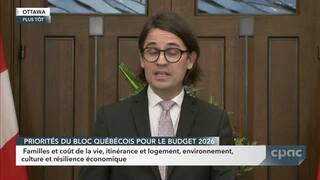
Few asks on record came from forest companies or their associations. The minister's promise of strategy details was kept, and the government can claim it. Duty relief, the Bloc's main forestry ask, is absent, and the softwood file is the next cycle's agenda. Worker support came as programs already announced, which leaves the Bloc's dollar figures open as a line of attack.
Asks compiled by Stephen Taylor's AI Public Affairs Toolset, September 15 to November 5, 2026.
The first risk is the gap between the announcement and the books. The chapter's three parts add to $6.5 billion over six years (calculated), while the cost table shows $2,216 million over five (Budget 2026: Masters of Our Destiny, Chapter 1 cost table). Much of the difference is the EDC money, counted as cash lent or invested. If the Accelerator's terms are commercial, the headline figure overstates the subsidy to any single firm.
The second is delivery. The Accelerator sits in EDC's Canada Account, which Chapter 2 proposes to enlarge and give new governance (Budget 2026: Masters of Our Destiny, Chapter 2, s. 2.2). Chapter 6 launches the merger of BDC and EDC into a single federal development bank. A firm applying in 2027-28 may be dealing with an agency in transition.
The third is the duty file. The budget does not mention softwood lumber, and the trade remedy consultations it announces cover duties Canada imposes on imports (Budget 2026: Masters of Our Destiny, Chapter 2, s. 2.2). Those duties applied to about $3.3 billion of imports in 2025. They do nothing for Canadian exporters paying U.S. duties.
The fourth is tax design. The Canada Growth Incentive exempts up to $15 million in capital gains on new shares of qualifying private companies, and a business in forestry does not qualify (Tax Measures: Supplementary Information, Canada Growth Incentive). Owners of small sawmills and contractors lose a tool that technology and manufacturing founders gain.
The fifth is fibre. Fires burned about 4.5 million hectares in 2026 (Budget 2026: Masters of Our Destiny, Chapter 5, s. 5.4). The $2.5 billion EDC line of financing for De Havilland waterbombers adds firefighting capacity over time, and the budget prints no estimate of timber losses. Market risk sits on top. The plan assumes a dollar at 72.1 US cents in 2026 and 72.4 US cents in 2027, and U.S. growth of 2.1 per cent and 2.2 per cent (Budget 2026: Masters of Our Destiny, Annex 1, Table A1.2). A stronger dollar or weaker U.S. housing would cut mill revenue.
Natural Resources Canada's $2 billion modernisation stream covers facilities, equipment, productivity, higher-value products and research, development and demonstration, over six years from 2027-28 (Budget 2026: Masters of Our Destiny, Chapter 1, s. 1.3). Program rules and intake dates are not published.
The Forestry Sector Accelerator is for large projects. It will invest in new large-scale facilities and in major transformations of existing ones, including biorefineries, biofuel plants and other higher-value products. The $4 billion is on a cash basis over six years from 2027-28.
The $500 million fibre stream supports provinces, territories, Indigenous partners and industry in forest management and new technologies. Companies with tenure partnerships are likely partners for this stream.
The Productivity Mega Deduction lets firms write off most new capital assets in full and permanently (Budget 2026: Masters of Our Destiny, Chapter 1, s. 1.1). The legislative proposals were released September 15, 2026. Property acquired on or after September 15, 2026 qualifies (Budget in Brief).
Tariff programs remain open. The Regional Tariff Response Initiative has reached nearly $3.5 billion, with added support named for forestry (Budget 2026: Masters of Our Destiny, Chapter 2, s. 2.3). The $2 billion Canada Strong Diversification Fund pays for shovel-ready projects, including repairs to equipment and buildings. The Large Enterprise Tariff Loan Facility now offers more money per firm and longer terms. The Workforce Retention and Retraining Program helps employers keep and train staff during downturns.
Indigenous partnerships have new financing. The Tla'amin deal shows the loan guarantee program will finance tenure purchases. Annex 3 would let the First Nations Finance Authority lend to Indigenous-owned special purpose vehicles (Budget 2026: Masters of Our Destiny, Annex 3).
Housing demand has two openings. Build Canada Homes gets $13 billion more from 2028-29. Chapter 2 also commits to aligned approvals for new building materials and prefabricated homes across jurisdictions (Budget 2026: Masters of Our Destiny, Chapter 2, s. 2.4).
The government presents forestry as a resource strength to modernise. Section 1.3 groups it with critical minerals under "delivering more of what the world needs" and says the sector "must improve its productivity and competitiveness to keep pace" (Budget 2026: Masters of Our Destiny, Chapter 1, s. 1.3). The money follows that framing. It pays for new capacity and new products and does not compensate for duties.
This suggests Ottawa expects U.S. duties to last and wants the industry to depend less on U.S. lumber sales. Biorefineries and biofuels fit the budget's net-zero chapter. The $4 billion through EDC keeps most of the package off the accrual books.
Fiscal rules shape the design. The forest row is marked as capital investment, so it does not count against the day-to-day operating balance, which turns to an $11.2 billion surplus in 2027-28 (Budget 2026: Masters of Our Destiny, Annex 1, Table A1.6). Silence on softwood suggests the government is keeping duty relief out of the fiscal plan.
| Date | What happens | What it means for this client |
|---|---|---|
| July 31, 2026 | Wood cabinet and vanity surtax order takes effect | Imported cabinets and vanities pay a surtax |
| September 8, 2026 | Canada's proportional countermeasures on U.S. goods take effect | U.S. inputs may carry counter-tariffs unless remitted |
| September 15, 2026 | Productivity Mega Deduction announced, legislative proposals released | Draft rules for full write-offs of mill equipment are public |
| October 21, 2026 | Last of the tariff support announcements booked in Chapter 2 | Current forestry relief is what was announced by this date |
| November 5, 2026 | Canada Growth Incentive applies to qualifying shares issued from Budget Day | Forestry businesses are excluded |
| End of January 2027 | Full fuel excise relief ends, half rates to end of March | Diesel for harvesting and hauling costs more from February |
| April 1, 2027 | Fuel excise tax returns to standard rates | Full diesel tax returns |
| 2027-28 | Forest sector package and Forestry Sector Accelerator begin | First year of new money, six years in total |
| 2028-29 | Build Canada Homes capital top-up begins | New lumber demand from non-market housing |
For government. The $2,216 million booked for the forest sector over five years starts in 2027-28, so mills facing U.S. duties this year depend on tariff programs announced before the budget. The supporting figures are the zero in 2026-27 and the $554 million a year that follows.
For investors. Forestry's marginal effective tax rate falls to 1.8 per cent against 19.7 per cent in the United States, which makes a new mill or biorefinery cheaper to build here than south of the border. The $4 billion Forestry Sector Accelerator adds a Crown co-investor for large projects.
For members and media. Wildfires burned about 4.5 million hectares in 2026, and $500 million over six years for fibre supply and forest management is the only new money aimed at the wood supply itself. The frame ties the sector's future to fibre and to provincial partners.
The Bloc Québécois will say the budget ignored its call to buy back duties and its $2 billion wage subsidy ask. Quebec and British Columbia media are likely to lead with the absence of any softwood measure after a minister promised forest strategy details.
The Conservatives will focus on the $62.3 billion deficit for 2026-27 (Budget 2026: Masters of Our Destiny, Annex 1, Table A1.8). They may also cite $16.6 billion in tariff support announced since the spring as spending without a trade deal. The forest package is a small part of that argument.
Provincial governments own most forest land and set stumpage. They are likely to welcome the $500 million fibre stream and ask how much of it flows through them. British Columbia may point to the Tla'amin deal as a model.
The Parliamentary Budget Officer and fiscal commentators are likely to note that capital-classed spending and Crown lending keep the package mostly outside the operating balance. The business press will report the 1.8 per cent tax rate. Environmental groups may test whether biofuel and biorefinery projects come with emissions conditions, which the budget does not set.
The exchange rate against the 72.4 US cent assumption for 2027 and U.S. growth against 2.2 per cent will drive lumber revenue (Budget 2026: Masters of Our Destiny, Annex 1, Table A1.2). U.S. duty rates and any trade deal are the largest variable, and the budget assumes tariffs persist.
The 2027-28 Main Estimates will show the NRCan forest lines and the Canada Account authority. Program guidelines and intake dates for the $2 billion stream and the Accelerator will show who qualifies. Regional Tariff Response Initiative reports will show how much of the nearly $3.5 billion reaches forestry.
The EI premium rate of $1.64 per $100 of insurable earnings for 2027 sets payroll costs, and tariff-related EI measures push it up (Budget 2026: Masters of Our Destiny, Annex 1). The budget implementation bill will carry the Canada Account and First Nations Finance Authority changes. The spring economic update will restate the tariff outlook and any new sector support.