No concessions on supply management with the U.S.
Government of Quebec, release, Nov 4
Supply management is not mentioned.
—
Follow Stephen Taylor’s newsletter for federal budget intelligence, policy signals, and stakeholder-ready analysis.
Budget 2026 brief for dairy, poultry and egg groups: supply management goes unmentioned, while barns join the $36,055 million Mega Deduction.
Kickstarting Canada's Investment Supercycle with the Productivity Mega Deduction
$36,055M over 5 years
Lets farms write off barns, silos, tractors and other equipment in full in the year of purchase, on a permanent basis (Chapter 1, s. 1.1).
Securing a resilient food supply chain – National Food Security Strategy
$1,585M over 5 years
Funds processing capacity through a $1 billion Farm Credit Canada fund and two smaller funds, with nothing aimed at quota-based production (Chapter 3, s. 3.2).
New free trade agreements and negotiations
No cost line
Commits to finishing talks with Mercosur, ASEAN, India and the Philippines in the coming months, with no word on supply management (Chapter 2, s. 2.2).
Expansion of the Intergenerational Farm and Fishing Property Rollover
$65M over 5 years
Extends the tax-deferred farm transfer to nieces, nephews, grandnieces and grandnephews for transfers on or after January 1, 2027 (Chapter 6, s. 6.1).
Strengthening the effectiveness of fines and penalties
-$186M over 5 years
Raises penalties under the Health of Animals Act, the Feeds Act and four other farm statutes, as part of an economy-wide revenue measure (Chapter 6, s. 6.3).
“The budget lists barns and silos among the assets farms can now write off in year one under a $36,055 million deduction, and stable farm incomes mean that relief turns into construction quickly.”
“Ottawa wants to double preferential trade access to more than 3 billion consumers, including through a Mercosur deal, and supply-managed farmers need to see how that access is paid for.”
“The government is fighting food inflation with a $4,055 million benefit top-up and $1,585 million for grocery competition and processing, which shows where it sees the problem in the food chain.”
For dairy, poultry and egg producer groups this is a budget of silence on the core file and modest help at the edges. The farm-level gains come through write-offs, succession rules and lending law. The trade file, which matters most to the system, gets statements about negotiations and no mention of the sector.
| Measure | Five-year net ($M) | 2026-27 ($M) | Starts | Home page |
|---|---|---|---|---|
| Productivity Mega Deduction | 36,055 | 2,015 | Announced September 15, 2026 | Tax measures |
| National Food Security Strategy | 1,585 | 132 | Announced June 2026 | Agriculture |
| New free trade agreements and negotiations | No cost line | No cost line | Not dated | Trade |
| Intergenerational farm and fishing rollover expansion | 65 | 0 | January 1, 2027 | Tax measures |
| Strengthening the effectiveness of fines and penalties | -186 | 0 | 2027-28 | Expenditure review |
A negative figure means offsets or revenue exceed the gross cost, a net gain to the budgetary balance.
Productivity Mega Deduction. The budget's farming examples include tractors, combines, balers, forage harvesters, frame or metal barns, greenhouses and silos (Budget 2026: Masters of Our Destiny, Chapter 1, s. 1.1). The marginal effective tax rate on new agriculture and fishing investment falls from 7.6 per cent to -6.0 per cent, below the U.S. rate of 7.2 per cent. A deduction is worth most to a farm with steady taxable income. Quota-based farms, with predictable prices, are better placed to use it in the year they build than grain or cattle farms in a loss year. Only $2,015 million of the cost falls in 2026-27, and the chapter gives no date from which purchases qualify.
National Food Security Strategy. The strategy was announced in June and is booked at $1,585 million over five years (Budget 2026: Masters of Our Destiny, Chapter 3, s. 3.2). Its producer-facing parts are a $1 billion Agri-food Project Finance Fund through Farm Credit Canada, a $150 million Food Security Fund and a $100 million Collaborative Food Innovation Fund. These help farmer-owned processing ventures. None of the four objectives names dairy, poultry or eggs.
Trade agreements. Canada concluded deals with Ecuador, Indonesia and the United Arab Emirates. It aims to finish ASEAN, the Philippines, India and Mercosur "in the coming months" (Budget 2026: Masters of Our Destiny, Chapter 2, s. 2.2). Each is a negotiation where dairy and poultry access can be on the table.
Farm succession. The rollover covers transfers on or after January 1, 2027, to a niece, nephew, grandniece or grandnephew (Tax Measures: Supplementary Information). On supply-managed farms, quota is often the largest asset, so the wider family circle matters where no child takes over.
CFIA penalties. Six farm statutes, including the Health of Animals Act and the Feeds Act, get higher fines and stronger enforcement (Budget 2026: Masters of Our Destiny, Chapter 6, s. 6.3). The $186 million in net revenue over four years from 2027-28 is economy-wide, and the budget gives no farm share.
Asks compiled by Stephen Taylor's AI Public Affairs Toolset, September 15 to November 5, 2026.
No dairy, poultry or egg association ask appears in the pre-budget record. The Government of Quebec carried the system's main demand, and the budget did not answer it. What the sector got was announced before budget day. Trade access and research capacity are the next cycle's agenda.
The main risk is trade. The budget says Canada "chose to walk away" from the United States when it "asked too much and offered too little" (Budget 2026: Masters of Our Destiny, Chapter 2, s. 2.2). It does not say what was asked. Under the current law, passed in 2025, the trade minister may not make new supply management concessions in trade agreements. The budget neither restates that protection nor adds to it. Mercosur includes Brazil, one of the world's largest poultry exporters, and Argentina and Uruguay, which export dairy. A deal "in the coming months" will test the law early.
The second risk is how the budget frames food prices. Chapter 3 says Canadians "continue to face high levels of food price inflation" and blames weak grocery competition, low technology use and foreign suppliers (Budget 2026: Masters of Our Destiny, Chapter 3, s. 3.2). The budget also plans a consultation on suppliers that press retailers not to discount below a set price (Budget 2026: Masters of Our Destiny, Chapter 1, s. 1.5). If that consultation leads to new Competition Bureau powers, processors of dairy and poultry products would be in scope as suppliers. Farm-gate pricing would stay outside it. The debate over food prices would still move closer to the system.
Regulatory costs rise. Higher penalties under the Health of Animals Act and the Feeds Act cover disease control and feed rules. Poultry and egg producers work under those rules daily (Budget 2026: Masters of Our Destiny, Annex 3). The budget gives no penalty levels.
Departmental capacity keeps shrinking. Budget 2025 cut Agriculture and Agri-Food Canada by $154.7 million a year from 2028-29 and the Canadian Dairy Commission by $0.8 million a year (Budget 2025: Canada Strong, Annex 3, Table A3.2). Budget 2026 prints no update. Input costs also climb back as full fuel excise rates return on April 1, 2027 (Budget 2026: Masters of Our Destiny, Chapter 3, s. 3.1).
The Productivity Mega Deduction is the largest opening. Barns, silos and equipment would be deducted in full in the year of purchase, on a permanent basis. The Canada Revenue Agency will rule on specific assets once legislation is tabled (Budget 2026: Masters of Our Destiny, Chapter 1, s. 1.1). The budget excludes "certain long-lived buildings" without defining them, so the treatment of large modern barns is not yet settled.
The food strategy's processing money is open now. The budget says funding streams are open to applicants and proposals are under review (Budget 2026: Masters of Our Destiny, Chapter 3, s. 3.2). The $100 million Collaborative Food Innovation Fund is described as helping "producers expand agri-food processing," which fits producer-owned cheese, yogurt or egg-product ventures.
The rollover expansion applies from January 1, 2027, at a cost of $15 million a year from 2027-28 and $20 million in 2030-31 (Tax Measures: Supplementary Information). Annex 3 adds Canadian Agricultural Loans Act amendments to improve access to capital, support intergenerational farm transfers and cut costs for lenders and producers (Budget 2026: Masters of Our Destiny, Annex 3). The budget gives no new loan limits.
Counter-tariff costs on U.S. inputs are contained. Non-steel goods used in agricultural production qualify for automatic relief under the United States Surtax Remission Order (2025) (Budget 2026: Masters of Our Destiny, Chapter 2, s. 2.3). The Strategic Response Fund gets $1 billion over six years from 2028-29 and names agri-food among its targets (Budget 2026: Masters of Our Destiny, Chapter 1, s. 1.1).
The government is running food policy through the affordability chapter. It says the strategy "puts Canadians back in control of what we grow, what we buy, and what we put on our tables" (Budget 2026: Masters of Our Destiny, Chapter 3, s. 3.2). The tools are grocery hubs, the Competition Bureau, processing finance and a one-time Canada Groceries and Essentials Benefit top-up of $4,055 million in 2026-27. This suggests the government prefers to answer food prices with income support and retail competition, which leaves the supply-managed system alone.
On trade, the budget pairs firmness with the United States and speed elsewhere. It says "any trade deal must respect Canada's sovereignty and the right of Canadians to determine our own economic future" (Budget 2026: Masters of Our Destiny, Chapter 2, s. 2.2). That language fits a defence of supply management, and Quebec's demand, without naming it. The budget's title, Masters of Our Destiny, has the same tone.
The fiscal rules favour tax relief over programs. The budget counts forgone revenue from capital-focused tax incentives, $9.9 billion in 2026-27, as capital investment. The Mega Deduction therefore does not weigh on the day-to-day operating balance (Budget 2026: Masters of Our Destiny, Annex 1, Table A1.6). Farm support delivered through write-offs is cheaper under the government's own anchor than new income programs.
| Date | What happens | What it means for this client |
|---|---|---|
| June 2026 | National Food Security Strategy launched | Processing funds open to applicants |
| September 8, 2026 | Proportional countermeasures on U.S. goods announced | Automatic relief covers non-steel inputs for agricultural production |
| September 15, 2026 | Productivity Mega Deduction announced | Barns, silos and equipment move toward full expensing |
| January 1, 2027 | Rollover expansion takes effect | Transfers to nieces and nephews can be tax-deferred |
| January 31, 2027 | Full fuel excise relief ends | Half rates apply to March 31, 2027 |
| April 1, 2027 | Standard fuel excise rates return | Diesel and gasoline costs rise for farms and haulers |
| 2027-28 | Higher CFIA penalties begin to raise revenue | Health of Animals Act and Feeds Act violations cost more |
| 2028-29 | Strategic Response Fund recapitalisation begins | $1 billion over six years, with agri-food named |
For government. The budget lists barns and silos among the assets farms can now write off in year one under a $36,055 million deduction, and stable farm incomes mean that relief turns into construction quickly. The supporting figure is the fall in the tax rate on new agriculture investment to -6.0 per cent.
For members. Ottawa wants to double preferential trade access to more than 3 billion consumers, including through a Mercosur deal, and supply-managed farmers need to see how that access is paid for. The supporting fact is that the budget does not mention the system in any chapter.
For media. The government is fighting food inflation with a $4,055 million benefit top-up and $1,585 million for grocery competition and processing, which shows where it sees the problem in the food chain. The supporting figures are payments of up to $339 for a single person and $679 for a couple with two children.
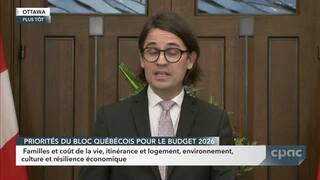
The Bloc Québécois will say the budget is silent on supply management in a year of open trade talks, and will point to Quebec's November 4 demand for no concessions. The Bloc's call to restore agri-food research centres adds a second line on Budget 2025's science cuts.
The Conservatives will focus on diesel and the cost of farm inputs. They asked to remove all federal taxes on diesel until July 1, and the budget restores full excise rates on April 1, 2027. They are likely to tie that to food prices.
The NDP will press its call for public grocery stores and call the Competition Bureau money too small against grocery profits. Free-market commentators and some business columnists are likely to use the budget's own words on food inflation to argue that supply management raises prices. The budget gives them a frame without taking a side.
The Parliamentary Budget Officer and fiscal commentators will look at the $62.3 billion deficit in 2026-27. They will also note that the operating balance turns to an $11.2 billion surplus in 2027-28 only because forgone revenue counts as capital investment (Budget 2026: Masters of Our Destiny, Annex 1, Table A1.6). The farm write-offs sit inside that adjustment.
Food inflation is the political number. The private sector forecast puts CPI inflation at 2.8 per cent in 2026 and 2.2 per cent in 2027 (Budget 2026: Masters of Our Destiny, Annex 1, Table A1.2). Grocery prices above that line keep supply management in the affordability debate.
Interest rates set the cost of quota and barn financing. The forecast has the three-month treasury bill rising from 2.3 per cent in 2026 to 2.6 per cent in 2027. The 10-year bond rises from 3.6 per cent to 3.8 per cent (Budget 2026: Masters of Our Destiny, Annex 1, Table A1.2). The exchange rate, at 72.4 U.S. cents in 2027, affects the price of imported dairy and poultry products.
On trade, the texts of the Mercosur, ASEAN and India agreements will show whether any tariff-rate quota is opened. On tax, the Mega Deduction bill will set the building exclusions for property acquired on or after September 15, 2026, the start date in the Budget in Brief. The Budget Implementation Act will carry the CFIA penalty and Canadian Agricultural Loans Act amendments. The 2027-28 Main Estimates will show Agriculture and Agri-Food Canada's budget after the review cuts, and the spring economic and fiscal update will restate the tariff outlook.