
Stakeholder Intelligence

Get the full stakeholder briefing.

Follow Stephen Taylor’s newsletter for federal budget intelligence, policy signals, and stakeholder-ready analysis.

Stakeholder Memo

Federal Budget 2026: Chamber of Commerce Stakeholder Brief

Budget 2026 brief for chambers of commerce: the $36,055 million Mega Deduction meets the top ask, and small firms get instalment relief without a rate cut.

ShareXLinkedIn

Top Budget Measures

Kickstarting Canada's Investment Supercycle with the Productivity Mega Deduction

$36,055M over 5 years

Permanent immediate write-off of assets the budget says make up more than 65% of investment, the Canadian Chamber's top pre-budget ask (Chapter 1, s. 1.1).

Supporting Canadian workers and businesses

$11,324M over 5 years

Books the tariff packages announced since May, including $1.5 billion more for the Regional Tariff Response Initiative and a $500 million BDC stream (Chapter 2, s. 2.3).

Making it easier for Canadians to manage their taxes

$821M over 5 years

Higher instalment thresholds, one annual instalment for self-employed owners and a single May 15 filing date cut compliance work for small firms (Chapter 6, s. 6.1).

Backing Canada's next generation of entrepreneurs

$715M over 5 years

A capital gains exemption of up to $15 million for founders and investors in qualifying firms, plus a longer reinvestment window for small business share sales (Chapter 1, s. 1.1).

Unleashing billions for Canadian businesses with the Canada Investment Summit

$181M over 5 years

Expands Invest in Canada with financial expertise and offices in key markets, and makes it the organiser of future summits (Chapter 1, s. 1.1).

Risks & Opportunities

Risks

  • ●The Mega Deduction leaves retail trade at a 19.3% tax rate on new investment and wholesale at 18.6%, so Main Street members gain far less than manufacturers (Chapter 1, s. 1.1).
  • ●Counter-tariffs matching U.S. rates are assumed to stay into 2027-28, and importers pay them until remission claims are processed (Annex 1).
  • ●Tariff-related Employment Insurance costs are recovered through future premiums, with $2,188 million in projected premium revenue from Budget 2026 measures (Chapter 3 cost table).
  • ●BDC and EDC are to merge into a single development bank under a transition board, with legislation and consultation still ahead (Chapter 6, s. 6.3).
  • ●Public debt charges rise from $60.2 billion in 2026-27 to $85.5 billion in 2030-31, which limits room for the rate cuts small business asked for (Annex 1, Table A1.8).
  • ●Stamp rates rise to $2.00 in 2027 and 7% a year after, which the budget prices at about $9 a year for a small business (Chapter 6, s. 6.3).

Opportunities

  • ●The Productivity Mega Deduction gives a permanent immediate write-off of eligible capital, with cost booked from 2026-27 and legislation still to be tabled.
  • ●A Cabinet directive requiring regulators to cut $2 of burden for every $1 added, with competitiveness assessments targeted for winter 2027 (Chapter 1, s. 1.5 and Chapter 6, s. 6.2).
  • ●More than 2,000 businesses supported through 30 domestic trade missions, and a 30-day service standard for credential recognition (Chapter 2, s. 2.4).
  • ●Trade agreements concluded with Ecuador, Indonesia and the United Arab Emirates, and talks with ASEAN, the Philippines, India and Mercosur to finish in the coming months (Chapter 2, s. 2.2).
  • ●The Small Business Procurement Program will align procurement rules with the Buy Canadian Policy and simplify bidding for small and medium-sized firms (Chapter 1, s. 1.5).
  • ●Bill C-39 would set one federal decision within one year of a complete application, backed by $187.4 million for a major projects management entity (Chapter 2, s. 2.1 and Chapter 6, s. 6.2).

Suggested Message Frames

“The $36,055 million Productivity Mega Deduction answers business's top ask and covers property acquired on or after September 15, 2026, so its value depends on legislation being tabled quickly.”

“Main Street retail still faces a 19.3% tax rate on new investment after the deduction, three times the 6.4% economy-wide rate, so small firms need the second tranche of tax simplification in spring 2027.”

“Counter-tariffs have raised $14.1 billion, and $8.9 billion has been remitted or relieved, so faster remissions are the quickest cash relief for importing members.”

Executive Summary

  1. The Canadian Chamber's top ask arrived in full, yet the $36,055 million Productivity Mega Deduction leaves retail trade at a 19.3% tax rate on new investment, three times the 6.4% economy-wide rate (calculated), so Main Street members still face a far higher rate than manufacturers, at -1.2%.
  2. The largest tax item aimed at small firms is instalment relief worth $395 million over five years, and none of CFIB's asks on the small business rate, EI premiums or the GST/HST threshold appears.
  3. The $11,324 million tariff line re-books packages announced since May, and BDC's revenue floor falls only to $1 million, so the smallest members remain outside the programs.

For a chamber the budget splits its membership. Capital-heavy members get a permanent tax cut. Service and retail members get less paperwork. Exporters get new agreements and tariff aid that is mostly money announced before.

Top 5 Relevant Budget Measures

Measure Net 5-year cost ($M) 2026-27 ($M) Start Source
Productivity Mega Deduction* 36,055 2,015 2026-27, legislation to come Chapter 1, s. 1.1
Supporting Canadian workers and businesses* 11,324 2,178 Announced May to October 2026 Chapter 2, s. 2.3
Making it easier for Canadians to manage their taxes 821 16 2027 and 2028 taxation years Chapter 6, s. 6.1
Canada Growth Incentive 715 0 Budget Day and January 1, 2027 Chapter 1, s. 1.1
Invest in Canada expansion 181 0 2027-28 Chapter 1, s. 1.1

* Includes funding classified as capital investment.

1. Productivity Mega Deduction. The budget's own table shows who gains (Budget 2026: Masters of Our Destiny, Chapter 1, s. 1.1). Manufacturing falls to -1.2% and transportation to -2.3%. Retail trade falls only from 21.6% to 19.3% and wholesale from 21.3% to 18.6%. Services fall from 15.6% to 9.9%. Retail and wholesale stay well above the 6.4% average. This suggests much of their capital is buildings and inventory, which the deduction does not reach. The fiscal cost runs from $2,015 million in 2026-27 to $9,255 million in 2030-31.

Follow Stephen Taylor’s newsletter for federal budget intelligence and policy signals.

2. Tariff supports. The row books packages announced on May 4, June 3, August 25 and October 21, 2026 (Budget 2026: Masters of Our Destiny, Chapter 2 cost table). It is a re-announcement for members who followed those releases. The parts open to general members are $1.5 billion more for the Regional Tariff Response Initiative, a $500 million BDC Pivot to Grow stream and a $2 billion Canada Strong Diversification Fund. The initiative has supported about 1,200 businesses since fall 2025, with steel and automotive targets exceeded.

3. Tax administration. Instalment thresholds rise to $7,500 and are indexed, which the budget says takes 185,000 small incorporated businesses out of instalments (Budget 2026: Masters of Our Destiny, Chapter 6, s. 6.1). A single May 15 filing and payment date starts with the 2027 taxation year. The separate $236 million business package exempts CCPC dividends from the taxable preferred share rules and triples the dividend allowance to $1.5 million. These are cash-flow and compliance gains with no change to rates.

4. Canada Growth Incentive. The exemption excludes a long list of sectors, including agriculture, real estate, finance, food and accommodation, arts and recreation, plus professional practices and franchises (Tax Measures: Supplementary Information, Personal Income Tax Measures). It is a tool for technology and growth firms. The enhanced rollover from January 1, 2027 has no sector list and reaches more of a chamber's membership.

5. Invest in Canada. The agency gets $181.4 million over four years from 2027-28 and will run future summits (Budget 2026: Masters of Our Destiny, Chapter 1, s. 1.1). The budget says the September summit produced nearly $500 billion in commitments. Most of that is bank and pension fund financing, so local investment attraction gains a federal partner without a regional budget.
Asked For vs. Delivered

6 asks: 2 delivered 3 partly 1 not in this budget
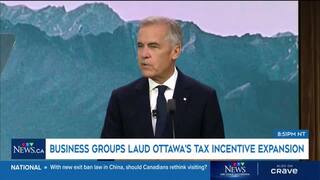
Matthew Holmes on CTV News Channel
Expand and extend the productivity super-deduction
Matthew Holmes, Canadian Chamber of Commerce, CTV News Channel, Sep 15
It is permanent and covers more than 65% of investment.
Delivered
Dan Kelly on CTV News Channel
Cut the small business tax rate from 9% to 6%
Dan Kelly, CFIB, CTV News Channel, Sep 16, and CFIB, release, Oct 7
The rate is unchanged.
–
Not in this budget
Return counter-tariff revenue to businesses hit by the trade war
$8.9 billion was remitted or relieved, with no rebate program.
Partly

Asks compiled by Stephen Taylor's AI Public Affairs Toolset, September 15 to November 5, 2026.

The Chamber's headline ask is a win to claim. The small business and tax reform asks that chambers share with CFIB and CPA Ontario go to the Spring Economic Update 2027, the next dated decision point.

Risks

  • Uneven tax relief. Retail and wholesale members gain least from the deduction, by the budget's own rates (Budget 2026: Masters of Our Destiny, Chapter 1, s. 1.1). If the second tranche of simplification in spring 2027 carries no rate or payroll change, then the gap between capital-heavy and labour-heavy members stays.
  • Counter-tariffs. Countermeasures matching U.S. rates took effect September 8, 2026, and Annex 1 assumes they remain into 2027-28. Customs import duties are forecast to rise 7.8% to $11.1 billion in 2026-27 (Annex 1). Importers carry that cost until remissions are processed.
  • Payroll. The 2027 EI premium rate is $1.64 per $100 of insurable earnings (Annex 1). The tariff row's EI costs are charged to the EI Operating Account and recovered through future premiums (Chapter 2 cost table).
  • Federal financing. BDC and EDC are to become one development bank, and the Canada Small Business Financing Program moves to BDC (Chapter 6, s. 6.3 and Annex 3). The budget says existing products are fully maintained. A merger still changes contacts, credit policy and timelines for members mid-pivot.
  • Fiscal room. The deficit is $62.3 billion in 2026-27 and public debt charges reach $85.5 billion by 2030-31 (Annex 1, Table A1.8). The operating balance turns positive in 2027-28 only because $16.8 billion of forgone revenue is added back (Annex 1, Table A1.6). Tax cuts that do not count as capital have little room.
  • Growth. Private sector forecasters put real GDP growth at 1.0% in 2026 and 1.7% in 2027 (Annex 1, Table A1.2). Those that quantified it put the drag from new U.S. tariffs at about 0.3 percentage points in each year.

Opportunities

  • Investment write-off. The Productivity Mega Deduction is permanent, and the Canada Revenue Agency will rule on specific assets once legislation is tabled (Chapter 1, s. 1.1).
  • Red tape. The Cutting Red Tape for All Canadians Act amends 31 laws and could save $264 million over 10 years for government and business (Chapter 6, s. 6.2). The new Cabinet directive requires regulators to cut $2 of burden for every $1 added.
  • Internal trade. Governments signed the Canadian Mutual Recognition Agreement on the Sale of Goods, and first ministers will work toward model mutual recognition legislation (Chapter 2, s. 2.4). The budget cites an IMF estimate of up to $210 billion a year from removing barriers.
  • Export markets. The government says it is on track to double preferential access from 1.5 billion to more than 3 billion consumers (Chapter 2, s. 2.2). Talks with Thailand and Türkiye have started.
  • Procurement. Public Services and Procurement Canada and the Treasury Board Secretariat are simplifying rules so small and medium-sized firms can bid on federal contracts (Chapter 1, s. 1.5).
  • Projects. Bill C-39 would run assessments and permits at the same time, with a decision within a year of complete information (Chapter 6, s. 6.2). The Build Communities Strong Fund backs local hospitals, recreation centres, bridges, water and transit with $51 billion over 10 years from 2026-27, and the budget names projects in every province and territory (Chapter 3, s. 3.2).
  • Capital. The Canada Strong Fund gets an initial $25 billion over three years to co-invest with private investors, with legislation in the coming months (Chapter 2, s. 2.1).

Likely Government Intent

The government wants private investment to carry growth. Its stated goal is "Canada's Investment Supercycle," and the Mega Deduction gives Canada "the lowest tax rate on new business investment of any major economy" (Budget 2026: Masters of Our Destiny, Chapter 1, s. 1.1). The fiscal design rewards that choice. Forgone revenue from capital tax incentives counts as capital investment in the operating balance, $9.9 billion in 2026-27 (Annex 1, Table A1.6). A small business rate cut gets no such treatment.

The competition plan is the second theme. Its slogan, "More choice. Lower prices. Stronger growth.", covers non-compete limits, red tape cuts and internal trade (Chapter 1, s. 1.5). The title, Masters of Our Destiny, frames trade diversification and domestic integration as responses to U.S. tariffs. Chambers get a policy agenda they broadly support, with the cost relief aimed at capital.

Open Questions

  1. Finance, Tax Policy Branch. When will Mega Deduction legislation be tabled? Property acquired on or after September 15, 2026 qualifies (Budget in Brief), and members timing purchases need the final rules.
  2. Finance. Will the second tranche of tax simplification in the Spring Economic Update 2027 include the independent review business coalitions asked for? The budget sets five principles and no review.
  3. Finance and the BDC-EDC transition board. What is the timeline for the single development bank, and how will small business lending be protected during the merger? Many members borrow from BDC.
  4. Finance and Global Affairs Canada. Will counter-tariffs stay past 2027-28, and how fast will remission claims be processed? Net revenue is subject to revision as claims are paid.
  5. Treasury Board Secretariat. How will the $2-for-$1 rule be measured and reported? Without public reporting, members cannot test whether burden falls.

Key Dates

Date What happens What it means for this client
November 5, 2026 CCPC dividends exempt from taxable preferred share rules, and Canada Growth Incentive shares qualify from Budget Day Immediate changes for private corporations
January 1, 2027 Enhanced small business rollover applies Owners selling shares get three more years to reinvest
2027 Stamp rates rise to $2.00, then 7% a year Small mailing costs rise
Winter 2027 Competitiveness impact assessment built into federal regulation New rules carry a competitiveness test
Spring Economic Update 2027 Second tranche of tax simplification Next decision point for small business tax asks
2027 taxation year Single May 15 filing and payment date Simpler deadlines for self-employed members
2027-28 Counter-tariffs assumed to remain in place Import costs persist for the year
End of 2027 Up to 200,000 temporary residents become permanent residents More stable workforce for employers using temporary staff
2028 taxation year Instalment threshold rises to $7,500, indexed 185,000 small corporations stop paying instalments

Suggested Message Frames

  1. For government. The $36,055 million Productivity Mega Deduction answers business's top ask. It covers property acquired on or after September 15, 2026, and its value depends on legislation being tabled quickly (Budget in Brief).
  2. For members. Retail still faces a 19.3% tax rate on new investment after the deduction, three times the 6.4% economy-wide rate. The second tranche of tax simplification in spring 2027 is where small firms' asks go next.
  3. For media. Counter-tariffs have raised $14.1 billion and $8.9 billion has been remitted or relieved. Faster remissions are the quickest cash relief for importing members.

Opposition and Media Narratives to Anticipate

The Official Opposition will lead with the $62.3 billion deficit and $60.2 billion in public debt charges in 2026-27 (Annex 1, Table A1.8). It is likely to support the deduction and attack the operating balance as an accounting device. The NDP and labour groups are likely to call the deduction a corporate tax cut at a time of public service reductions. The Bloc Québécois asked for an end to the GST on used goods and is likely to raise it again. Quebec's government wants a larger federal share of infrastructure repair.

CFIB is likely to say small business was left out, with its rate, threshold and EI asks all unmet. CPA Ontario's coalition, which says it represents 700,000 businesses and professionals, will treat the spring 2027 tranche as a test. The business press will praise the deduction's scale and ask who benefits, and the budget's own sector rates answer that.

The Parliamentary Budget Officer is likely to focus on the operating balance. Without the forgone-revenue add-back it is -$5.6 billion in 2027-28 and turns positive only in 2028-29 (calculated from Annex 1, Table A1.6). Provincial governments will be asked whether they match the deduction, which decides its full value to members.

Data Points to Monitor

  • The Mega Deduction's legislative text, for property acquired on or after September 15, 2026.
  • Remission processing and net counter-tariff revenue, $5.2 billion as of October 26, 2026 (Annex 1).
  • Real GDP growth, forecast at 1.0% in 2026 and 1.7% in 2027, and the 10-year bond yield at 3.6% and 3.8% (Annex 1, Table A1.2).
  • Regional Tariff Response Initiative uptake by sector and region.
  • Bill C-39's progress and the first decisions under the one-year target.
  • The BDC-EDC transition board's plan and the CSBFP transfer legislation.
  • The Spring Economic Update 2027 and its second tranche of tax simplification.

Sources

  • 1.Budget 2026: Masters of Our Destiny, Chapter 1, s. 1.1 and s. 1.5
  • 2.Budget 2026: Masters of Our Destiny, Chapter 2, s. 2.1, s. 2.2, s. 2.3 and s. 2.4
  • 3.Budget 2026: Masters of Our Destiny, Chapter 3, s. 3.2 and cost table
  • 4.Budget 2026: Masters of Our Destiny, Chapter 6, s. 6.1, s. 6.2 and s. 6.3
  • 5.Budget 2026: Masters of Our Destiny, Annex 1, Tables A1.2, A1.6 and A1.8
  • 6.Budget 2026: Masters of Our Destiny, Annex 3
  • 7.Tax Measures: Supplementary Information, Personal Income Tax Measures and Business Income Tax Measures