Immediate 5% increase in the Canada Health Transfer to Quebec
Government of Quebec, release, Nov 4; Montreal Gazette, Nov 4; RDI, Nov 4
The CHT stays on its legislated escalator.
Federal Budget 2026 for Quebec: the Quebec Abatement recovers $8.5 billion in 2026-27, and Chantier Davie builds six Coast Guard icebreakers.
Quebec Abatement recovery from transfers, 2026-27
$8.5 billion
Rising to $9.8 billion by 2030-31
Six program icebreakers at Chantier Davie
Nearly 5,000 jobs
During construction; announced August 2026
VIA Rail fleet renewal
More than $6.6 billion
Designed in Saint-Bruno-de-Montarville, built partly in La Pocatière
National Field of Honour, Pointe-Claire
$15.9 million over four years
$2.1 million ongoing
Contrecoeur Container Terminal construction jobs
Up to 8,000
In-water construction began August 2026
Budget 2026 takes its title from a phrase coined in Quebec (background), and it names shipbuilding, munitions, rail-car and AI work in the province, most of it decided before budget day (Chapters 4 and 5). It does not answer Quebec City's fiscal demands on health, asylum costs or the Mega Deduction.
| Item | Amount | Regional share stated? | Source |
|---|---|---|---|
| Quebec Abatement (other fiscal arrangements) | -$8.5 billion in 2026-27, -$9.8 billion by 2030-31 | Yes. Recovered from Quebec's cash transfers | Annex 1, Table A1.10 |
| Six program icebreakers, Chantier Davie† | No amount in Chapter 5. Annex 1 books $33 million gross over five years (calculated), more than offset from existing DND funds. Nearly 5,000 construction jobs and nearly $650 million a year in GDP | Yes | Chapter 5, s. 5.1; Annex 1, Table A1.19 |
| Defence industrial base, including a nitrocellulose plant in Québec | Up to $2.7 billion (cash) from previously announced funding, -$39 million net | No | Chapter 5, s. 5.1 |
| VIA Rail fleet renewal† | More than $6.6 billion announced, $83 million booked over five years | No. Design and two plants named | Chapter 4, s. 4.2; Annex 1, Table A1.19 |
| Remote Passenger Rail Program | $35.1 million in 2027-28 | No. Shared with Manitoba and Newfoundland and Labrador | Chapter 4, s. 4.2 |
| National Field of Honour, Pointe-Claire | $15.9 million over four years, $2.1 million ongoing | Yes | Chapter 4, s. 4.1 |
| Global Partnership on AI centre, Montréal | $6.2 million over four years | Yes | Chapter 5, s. 5.2 |
| Regional Tariff Response Initiative top-up | $1.5 billion | No | Chapter 2, s. 2.3 |
| Cuts with a regional footprint | Not stated. Savings are not broken down by organization | No | Chapter 6 |
| Canada Health Transfer (national) | $57.4 billion in 2026-27 to $67.7 billion in 2030-31 | No. Per-province amounts are published separately | Annex 1, Table A1.10 |
| Equalization (national) | $27.2 billion to $31.9 billion | No. Quebec receives Equalization under the current program (background) | Annex 1, Table A1.10 |
| Health agreements (national) | $4.3 billion, falling to $2.5 billion in 2028-29 | No | Annex 1, Table A1.10 |
| Canada-wide early learning and child care (national) | $10.3 billion in 2026-27 to $8.8 billion in 2030-31 | No | Annex 1, Table A1.10 |
The Quebec Abatement is the one transfer line that belongs to Quebec alone. Québec residents pay lower federal taxes in lieu of federal cash for certain social programs, so "an equivalent amount is recovered from Québec's cash transfers" (Annex 1). The recovery grows by $1.3 billion (calculated) over the horizon, about 15% (calculated). The national Canada Health Transfer grows about 18% (calculated) over the same years.
Annex 1 says major transfers rose slightly since the Spring Economic Update 2026 on higher Equalization and CHT payments, "partially offset by higher recoveries under the Quebec Abatement." This suggests part of Quebec's gain from a stronger economy returns to Ottawa through its own tax arrangement. Quebec receives Equalization under the current program (background). The national pool grows 4.1% a year on average, and 2027-28 amounts are finalised in December 2026 (Annex 1, Table A1.10, note 2).
Health agreements fall by $1.8 billion (calculated) a year in 2028-29 as federal home care, mental health and long-term care transfers expire. The $1.2 billion extension for home care and mental health runs only to March 31, 2028 (Chapter 3, s. 3.3). If no new deal follows, Quebec loses its share of that money.
Child care follows the same pattern. Ontario's four-year extension is named in the budget, and Quebec's is not (Chapter 3, s. 3.1). Quebec runs its own system under an asymmetric agreement (background), and the budget says nothing about its renewal.
The budget gives no breakdown of spending review savings by department (Chapter 6). Canada Economic Development for Quebec Regions is named only as the department for $8 million in support for the International Sustainability Standards Board (Annex 1, Table A1.19). The Regional Tariff Response Initiative is delivered by "Canada's regional development agencies," which the budget does not name.
| Measure or project | Where | Amount | Source |
|---|---|---|---|
| Program icebreakers. Six new Coast Guard ships under an August 2026 agreement† | Chantier Davie | $33 million gross in Annex 1 (calculated), offset from DND funds | Chapter 5, s. 5.1; Annex 1, Table A1.19 |
| Defence industrial base. Completes a General Dynamics nitrocellulose plant for munitions | Québec | Part of up to $2.7 billion (cash), national | Chapter 5, s. 5.1 |
| Defence Innovation Secure Hubs. Uncrewed Systems hub launched July 2026 | Québec | No amount | Chapter 5, Figure 5.1 |
| Figure 5.1 defence work. Polar icebreakers, tugs, fighter infrastructure and conversion of the Husky fleet to tankers | Québec | No amounts | Chapter 5, Figure 5.1 |
| VIA Rail fleet renewal†. First Canadian-made cars in 40 years | Saint-Bruno-de-Montarville, La Pocatière | More than $6.6 billion; $83 million booked | Chapter 4, s. 4.2; Annex 1, Table A1.19 |
| Remote Passenger Rail Program. Renewed for one year | Québec, Manitoba, Newfoundland and Labrador | $35.1 million in 2027-28 | Chapter 4, s. 4.2 |
| Contrecoeur Container Terminal. Montreal Port Authority began in-water work in August 2026, supporting up to 8,000 jobs during construction | Contrecoeur | No cost line | Chapter 2, s. 2.1 |
| Matawinie graphite mine. Construction began May 2026, feeding the Bécancour battery hub | Saint-Michel-des-Saints | No federal amount in Budget 2026 | Chapter 2, s. 2.1 |
| Labrador Trough corridor. 14,000 megawatts and iron ore for low-carbon steel, referred August 17, 2026 | Newfoundland and Labrador and Québec | No federal amount | Chapter 2, s. 2.1 |
| Alto High-Speed Rail, in the Major Projects Office portfolio. Legislation for expropriation and early preconstruction | Ontario-Québec Corridor | No amount | Annex 3 |
| National Field of Honour. Ottawa takes ownership at the Last Post Fund's request | Pointe-Claire | $15.9 million over four years | Chapter 4, s. 4.1 |
| Global Partnership on AI. Keeps the international centre in Montréal | Montréal | $6.2 million over four years | Chapter 5, s. 5.2 |
| AI for All. Canada's stake in LawZero, alongside Germany's €100 million | Montréal | $150 million | Chapter 5, s. 5.2 |
| Regional Tariff Response Initiative example. Fjordal Aluminium productivity and capacity | Québec | $1,000,000 | Chapter 2, Figure 2.11 |
| Federal bridges consolidation. Victoria Bridge moves to the Minister of Housing and Infrastructure | Montréal | No cost | Chapter 6, s. 6.4, Figure 6.1 |
| Build Communities Strong Fund projects. Six named, plus the Hôpital de Chicoutimi as a past commitment | Pincourt, Notre-Dame-du-Laus, Québec, La Tuque, Gaspé, Sainte-Anne-de-Beaupré | No amounts | Chapter 3, s. 3.2 |
| Build Canada Homes. 108 affordable homes with Accès Patrimmo | Malartic | Not stated in text | Chapter 3, Figure 3.5 |
| Canadian Earthquake Insurance Facility. The budget names the region between Ottawa and Québec City as high-risk | Ottawa to Québec City | Up to $50 billion in emergency funding; -$154 million net | Chapter 5, s. 5.4 |
| Wine Sector Support Program. Renewed from 2027-28 | Eastern Townships, among four regions | $176.9 million over three years, national | Chapter 2, s. 2.3 |
| International Sustainability Standards Board support†. Delivered by Canada Economic Development for Quebec Regions | Not stated | $8 million | Annex 1, Table A1.19 |
† Earlier decision booked in Budget 2026, Annex 1 policy-actions table, not a new Budget 2026 measure.
A negative figure means offsets or revenue exceed the gross cost, a net gain to the budgetary balance.
Most of Quebec's named projects are status reports. Matawinie had federal financing before this budget. The Spring Economic Update 2026 listed about $462 million in debt and about $149 million in equity financing, announced in October 2025 (SEU 2026, Chapter 1). Alto's acceleration law was also promised in Budget 2025 (Budget 2025, Annex 5), and it returns this year with expropriation powers.
Aluminum. The budget says "aluminum and copper producers have benefited from tighter global supply conditions" (Overview). Canada raised counter-tariffs on most U.S. steel and aluminum products on September 8, 2026 (Annex 1). Aluminum is one of the sectors that got added Regional Tariff Response Initiative support (Chapter 2, s. 2.3). See steel and aluminum.
Forestry. Natural Resources Canada gets $2.5 billion (calculated) over six years from 2027-28 for fibre supply and mill modernisation, and Export Development Canada gets $4 billion on a cash basis for a Forestry Sector Accelerator (Chapter 1, s. 1.3). The money starts in 2027-28, so mills see none of it in 2026-27. See forestry.
Critical minerals and batteries. The exploration tax credits are extended to March 31, 2032, and antimony is added (Chapter 1, s. 1.3). Matawinie and Bécancour are the budget's Quebec battery examples. See critical minerals.
Shipbuilding and defence. Quebec and the Prairies have the longest lists in the budget's defence map, with five lines each, and Quebec also appears in two of the three multi-regional lines (Chapter 5, Figure 5.1). Davie's icebreakers add nearly 5,000 construction jobs. See shipbuilding and defence industry.
Aerospace. Up to $2.5 billion in financing for De Havilland waterbombers supports jobs in Wheatland County, Alberta (Chapter 2, s. 2.2). Quebec's aerospace firms can qualify for automatic surtax relief on steel goods used in aerospace manufacturing (Chapter 2, s. 2.3). See aerospace.
Electricity. The budget proposes to extend the Clean Electricity tax credit to intra-provincial transmission at 735 kV and above in Quebec (Tax Measures: Supplementary Information). See electricity.
Culture and media. The $600 million for audio and audiovisual sectors, announced June 3, is booked with $300 million more for CBC/Radio-Canada (Chapter 4 cost table). New Online Streaming Act policy directions come with no detail or timing (Chapter 4, s. 4.1). See arts and culture.
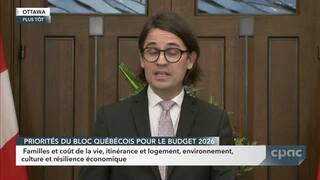
Asks compiled by Stephen Taylor's AI Public Affairs Toolset, September 15 to November 5, 2026.
Quebec City's asks were about money and jurisdiction, and the budget answered none of them. The Bloc did better on program renewals. Reaching Home and the Canada Housing Benefit both get 10 more years, and the $600 million for culture the Bloc asked Ottawa to deliver is booked in the Chapter 4 cost table. The Bloc's call for $4 billion more for EI compares with $3.9 billion in incremental EI costs that Annex 1 attributes to the worker measures in Chapters 2 and 3.
Social programs. Ottawa pays to build supportive and transitional housing, and "provincial and territorial partners will be expected to fund ongoing operations and wraparound services" (Chapter 3, s. 3.2). Reaching Home will require "rigorous reporting, including real-time data, as a condition for continued funding." Watch for Quebec's response to the new reporting conditions and to the operating bill.
Health care. The one-year health agreement extension is framed as relief while governments hold "a structured dialogue on the long-term productivity and sustainability of health care systems" (Chapter 3, s. 3.3). Quebec enters that dialogue with its CHT request unanswered.
Financial regulation. The budget says securities regulation "remains fragmented across 13 provincial and territorial jurisdictions" and calls Ontario's passport plan a step toward "a more integrated national capital market" (Chapter 2, s. 2.4). The earthquake facility needs provincial agreement to reach "provincially regulated insurers" (Chapter 5, s. 5.4). The budget does not give Quebec's position on either.
Quebec as the model. Ottawa will consult on requiring credit card payments above the minimum to go first to the highest-interest balance, "as is currently practised in Québec" (Chapter 3, s. 3.3). The new tax instalment threshold for Québec residents is $4,500, against $7,500 elsewhere, because their instalments cover federal tax only (Tax Measures: Supplementary Information). Québec is in the default group for the common cannabis excise stamp (Chapter 6, s. 6.1).
The budget is silent on supply management, which the Government of Quebec asked Ottawa to protect in full in talks with the United States (release, Nov 4).
It is silent on a federal contribution to repairing Quebec's infrastructure beyond the $10 billion announced in June, which Quebec also asked for. Its six named Quebec community projects carry no amounts.
It contains no aerospace industrial strategy, which the Bloc requested at the Finance Committee on Oct 6. It does not answer another Bloc ask, to apply the critical minerals strategy to phosphates in Saguenay–Lac-Saint-Jean. Phosphate is already on the exploration tax credit's critical minerals list, which the budget expands to add antimony (Notice of Ways and Means Motion).
It is silent on the Bloc's other fiscal asks, including 6% a year more in health transfers, a 10% Old Age Security increase for people aged 65 to 74, and a restored digital services tax.
It gives no update on a "one project, one review" co-operation agreement with Quebec. The Spring Economic Update 2026 listed finalised agreements with six provinces, and Quebec was not one of them (SEU 2026, Chapter 1).
| Date | Decision point |
|---|---|
| November 30, 2026 | Articles of Agreement for the Defence, Security and Resilience Bank signed in Luxembourg, after talks in Montréal. The budget places its headquarters in Canada without naming a city |
| December 2026 | 2027-28 Canada Health Transfer and Equalization amounts finalised |
| January 31, 2027 | Deadline for provinces to confirm the common cannabis excise stamp |
| Early 2027 | Grocery supplement paid out, and details of the renewed Reaching Home program |
| March 31, 2027 | Deadline Quebec set for federal repayment of its 2024 asylum costs |
| 2027-28 | Remote Passenger Rail money runs for this year only. Forestry money begins |
| Spring Economic Update 2027 | Reworked bilateral housing agreements |
| January 1, 2028 | $4,500 instalment threshold for Québec residents takes effect |
| March 31, 2028 | Home care and mental health agreements expire |
| 2028 | Francophonie Summit in the National Capital Region, with $393.2 million (cash) over three years |
| Legislation listed in Annex 3 (no date given) | Alto expropriation powers and the Canadian Earthquake Insurance Facility |